

This Content Is Only For Subscribers
Texas winter doesn’t ask permission. One gusty front and you’re juggling “no heat,” slick stairs, and a mystery drip in 2B. You can’t control the weather, but you can control your first 60 minutes. Stock these essentials now so a freeze becomes a checklist—not a crisis.
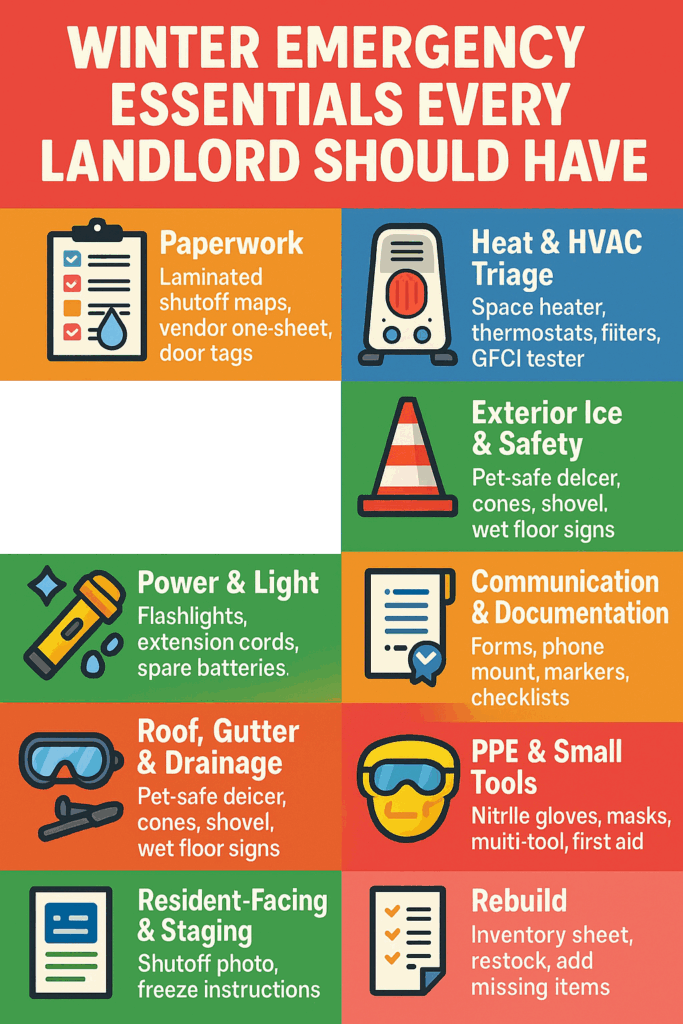
1) Paperwork that saves minutes (and money)
Laminated shutoff maps: Domestic main, risers/stacks, unit valves, irrigation/backflow. Keep a copy near the panel and in your phone.
Vendor one-sheet: Plumber, mitigation, HVAC, electrician, roofer—after-hours numbers, response-time SLAs, and “stabilize up to $____ without call” limits.
Door tags & text templates: Freeze alert, active leak notice, water-off notice. Print a few; save them in your phone, too.
2) Leak-stop & water control
Push-fit caps/couplings (common copper/PEX sizes), angle stops, supply lines (toilet/sink), Teflon tape.
Faucet/hose-bib covers and assorted pipe insulation sleeves with foil tape/zip ties.
Water key for curb stops + small meter wrench.
Wet/dry vac (with spare bags), squeegee, contractor bags, absorbent pads, microfiber towels.
Moisture meter and IR thermometer for fast diagnosis and documentation.
Why: You want to shut off the smallest zone, cap or stabilize, and start drying within minutes—before the thaw turns “drip” into “ceiling.”
3) Heat & HVAC triage
Tip-over-protected space heaters (loaners during repairs—never unattended).
Two simple thermostats (battery) + fresh batteries for quick swaps when smart stats glitch after power bumps.
Common filter sizes (label the stack).
GFCI tester and a couple of spare GFCI outlets for wet-area power issues.
Condensate line kit: tablets, brush, clear sight tee.
Why: In Texas, heat pumps plus wind equal trouble. Getting auxiliary heat online or swapping a flaky thermostat can save a midnight call.
4) Power & light
Headlamps and flashlights with spare batteries—hands free wins.
Heavy-duty, grounded extension cords (for supervised, temporary use only).
Surge-protected power strips for the office and a labeled breaker index at each panel.
5) Exterior ice & safety
Pet-safe deicer with hand spreaders staged at entries, stairs, mail areas.
Caution cones and folding wet floor signs.
Shovel, stiff broom, and leaf rake (for quick gutter/scupper clears).
Shoe-traction slip-ons and nitrile-coated gloves for staff.
Why: Most claims aren’t glamour leaks—they’re slips on a north-facing stair.
6) Roof, gutter, and drainage essentials
Downspout extenders/splash blocks to steer meltwater off walkways and away from slabs.
Tarps and plastic sheeting with painter’s tape/spring clamps for temporary containment until the roofer arrives.
7) Communication & documentation kit
Clipboard, Sharpies, blue tape, incident forms with time/contacts/action taken.
Phone mount for steady photos and eight-shot checklist: wide area, close problem, shutoff used, meter readings, mitigation setup, unit number/time stamp, and a “dry now” follow-up.
QR code on your kit lid linking to a shared drive/folder for uploads.
Why: Good records speed insurance, protect deductions, and make your CPA smile.
8) PPE & small tools
Nitrile gloves, N95 masks, Tyvek suit, safety glasses.
Utility knives, multi-tool, compact drill/driver, bit set, knee pads.
First-aid basics and eyewash bottle.
9) Resident-facing essentials
Printed shutoff photo for each unit (taped inside a kitchen cabinet).
One-page freeze instructions: set heat to 68–70°, open under-sink doors on exterior walls, drip cold water at at-risk faucets, and call for no heat immediately.
After-hours number posted in lobby/portal, not buried in an email from last year.
10) How to stage it (so people actually use it)
Pack items into mission bags:
- Blue—Leak Stop: push-fits, caps, angle stops, supply lines, Teflon, towels.
- Red—Heat/Power: thermostats, testers, batteries, space heaters.
- Green—De-ice/Exterior: deicer, spreader, cones, shovel.
- Yellow—Docs: forms, tags, risk/shutoff maps, vendor sheet.
Label shelves: “WINTER KIT—GRAB THIS FIRST.”
Tape a five-line playbook to the lid: Identify → Shutoff smallest zone → Stabilize/dry → Call vendors (parallel) → Document.
11) Two quick drills (15 minutes each)
Freeze/no-water: Open cabinets, warm the run safely, plumber on standby, slow re-pressurize with eyes on lines.
Active leak: Shut smallest zone, protect lower units, wet vac, vent baseboards, call plumber + mitigation in parallel, document.
Short, practiced moves beat heroics.
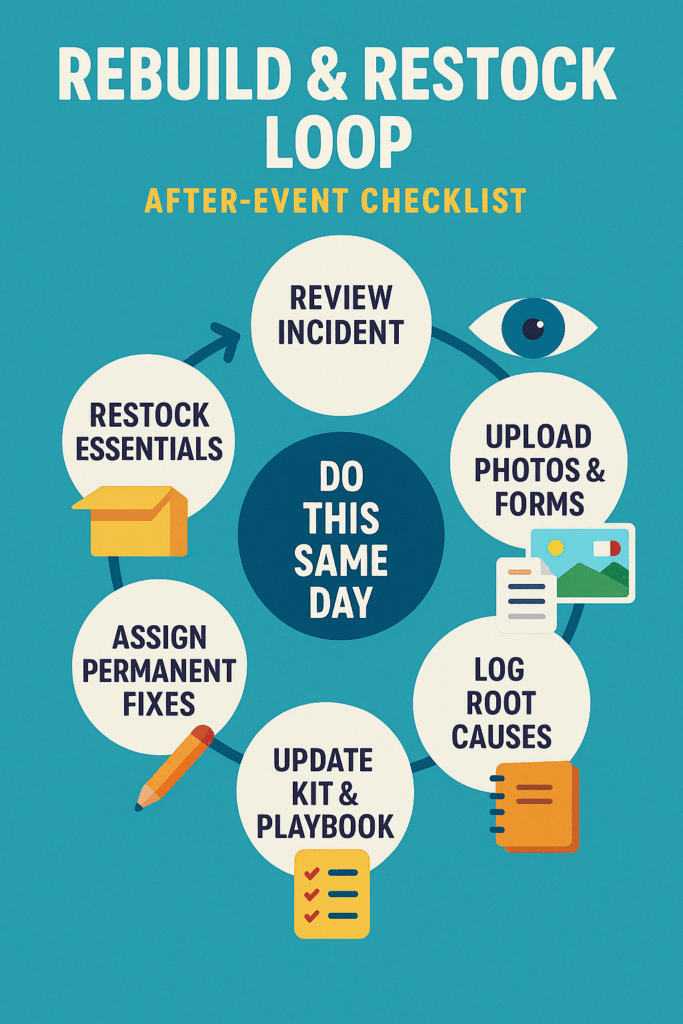
12) Rebuild after every event
Keep a laminated inventory checklist on the kit. As soon as the incident closes, restock what you used, upload photos, file the incident sheet, and add any “wish we’d had” items. Future you will be grateful.
The bottom line
Winter in Texas is about spikes, not seasons. Stock the essentials that solve the first hour—stopping water, keeping heat, preventing slips, and documenting the scene. Organize by mission, label like you’re tired, and practice twice. When the next blue norther blows through, you’ll move from panic to process in about thirty seconds.


