

This Content Is Only For Subscribers
The lease renewal process, while a routine aspect of property management, is a period uniquely fraught with the potential for conflict. It is the moment when the financial terms of the landlord-tenant relationship are re-negotiated, and misunderstandings or perceived unfairness can easily escalate into formal legal disputes. For the Texas landlord, the primary goal is not to win these disputes, but to prevent them from ever occurring. The most effective legal strategy is one of proactive risk mitigation, grounded in the principles of documentation, consistency, and professional communication.

The Doctrine of Documentation: Your Primary Defense
In any landlord-tenant dispute, the party with the clearer, more comprehensive documentation holds a significant advantage. A judge or mediator cannot rule based on what was said in a phone call or a hallway conversation; they must rely on the written record. Therefore, the cornerstone of dispute avoidance is the creation of a meticulous paper trail for every renewal.
•Put Everything in Writing: All offers, counter-offers, and notices related to the lease renewal must be in writing. This is non-negotiable. Verbal agreements or promises are a recipe for future conflict.
•Memorialize Verbal Conversations: If a substantive conversation about the renewal does occur, it is imperative to follow it up immediately with a written summary. An email stating, “To confirm our conversation this afternoon, you have requested an additional 48 hours to review the renewal offer. We will expect your decision by 5:00 PM on [Date],” transforms a fleeting conversation into a documented fact.
•Preserve Your Rationale: As discussed in a previous column, your justification for a rent increase must be based on objective market data. This research should not be discarded after the renewal offer is sent. It should be saved, either digitally or physically, in the property’s file. This file becomes your primary evidence to rebut any claim that a rent increase was arbitrary, retaliatory, or discriminatory.
The Shield of Consistency
Consistency is the landlord’s most powerful shield against claims of unfair treatment. The legal principle is simple: if you treat every tenant in a similar situation the same way, it becomes exceedingly difficult for one tenant to argue they are being singled out for punitive or discriminatory reasons. Inconsistency, on the other hand, can be interpreted as evidence of improper motive.
To build this shield, you must:
•Standardize Your Timeline: If your policy is to send renewal notices 60 days in advance, this timeline must be applied uniformly to all tenants. Making exceptions creates a weak point in your legal armor.
•Apply a Consistent Rent Logic: The methodology used to calculate rent increases should be consistent. If your increases are based on a percentage of the market rate, or a fixed percentage increase to cover rising costs, this logic must be applied across the board. Deviating for one tenant without a documented, legitimate business reason invites scrutiny.
•Enforce Rules Uniformly: If you are introducing new rules via a lease addendum, these rules must be enforced consistently for all residents. Selective enforcement of a pool rule or a parking policy can be used as evidence of harassment or discrimination.
The De-escalation of Professional Communication
The tone and manner of your communication can either escalate or de-escalate a potentially contentious situation. All communication with tenants, especially regarding financial matters, should remain professional, objective, and dispassionate.
•Use Neutral Language: The renewal offer should be a straightforward business document, not an emotional appeal. Stick to the facts: the new rate, the new term, and the deadline for acceptance.
•Respond, Do Not React: If a tenant pushes back against a rent increase, do not engage in an argument. You can professionally reiterate your position in writing, stating, “The proposed rental rate is based on our analysis of the current market for comparable properties in the area.” You are not obligated to negotiate, but you are obligated to remain professional.
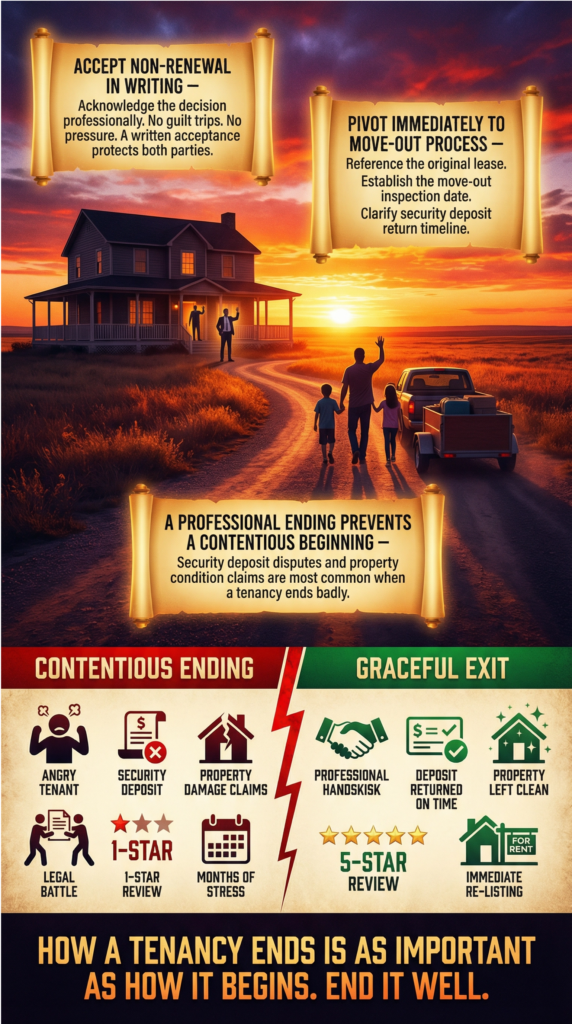
•Gracefully Accept a Non-Renewal: If a tenant decides not to renew, accept their decision in writing. Immediately pivot to the move-out process as outlined in the original lease. A contentious end to a tenancy can itself be a source of legal disputes over security deposits and property condition. A professional, orderly conclusion is always in your best interest.
Ultimately, avoiding legal disputes during the renewal process is not about mastering complex legal theory. It is about implementing and adhering to a disciplined, documented, and consistent business process. This approach not only provides a robust defense in the event of a conflict but, more importantly, it fosters a transparent and professional environment that makes such conflicts far less likely to arise in the first place.


