

This Content Is Only For Subscribers
December squeezes a lot of living into not-enough daylight. Guests show up, storms roll in, and suddenly your phone is a greatest-hits album of cold-weather chaos. Here’s a tight, human playbook for the calls you’ll hear most—and how to handle them without losing your cool.
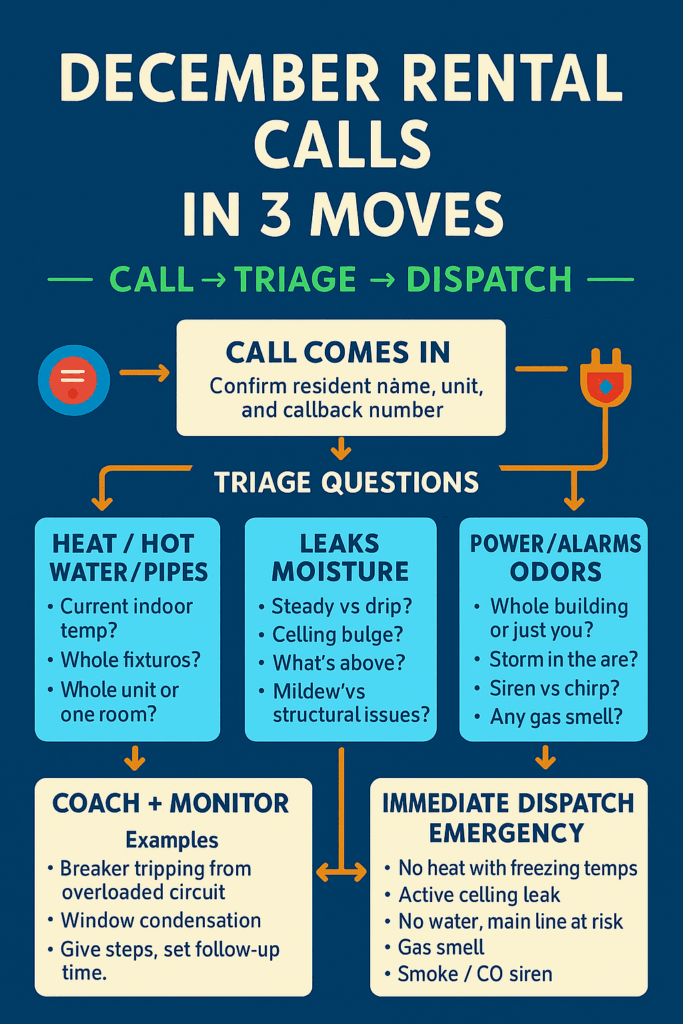
“The heat isn’t working.”
What to ask: Indoor temp, thermostat mode/setpoint, last filter change. Is it one room or the whole place?
Quick checks: Thermostat batteries, breaker/fuse, furnace switch, clogged filter, closed supply vents.
Dispatch when: Below habitability temps, gas odor, or no ignition after checks.
Say this:
“Let’s run a quick checklist so we can get heat fast. If it doesn’t fire, I’ll dispatch HVAC and text you the ETA.”
Pro tip: Do fall filter swaps and leave spare thermostat batteries in the unit.
“Pipes are frozen / no water.”
Ask: Which fixtures? Any water anywhere? Neighbors affected?
Immediate steps: Open under-sink cabinets, set heat to 68–70°F, slow cold-water drip at problem taps.
Dispatch when: No water to multiple fixtures during a freeze, a visible bulge, or main line risk.
Say this:
“We may be dealing with a freeze. Start a slow drip and open the cabinet doors. I’m sending maintenance now. If you see water, shut off the supply and call me.”
Pro tip: Tag unit shutoff valves and insulate known cold spots.
“Water is coming through the ceiling.”
Triage: Where is it? Steady or intermittent? What’s above (bath, roof, another unit)?
Action: Bucket, move belongings, immediate dispatch.
Say this:
“Thanks for calling quickly. Place a container under the leak and move items away. If the ceiling bulges, don’t touch it—we’re on the way.”
Pro tip: Keep a roofer on standby for ice-dam season; inspect shower caulk in multi-family units.
“The power’s out.”
Figure out: Building-wide or just one unit? Any weather event?
Checks: Main breaker, tripped GFCIs (kitchen/bath/garage).
If utility outage: Share the utility status link; advise food-safety steps.
If isolated/arcing: Send an electrician.
Say this:
“Looks like a wider utility outage. Here’s the status page. Keep the fridge closed and use flashlights—not candles. Ping me if it’s not back by [time].”
“The breaker keeps tripping when we cook.”
Likely culprit: Space heater + microwave or other high-draw combo.
Solution: Coach on staggering use; if it trips under normal load, schedule an electrician to assess the circuit.
Say this:
“That circuit is overloaded. Try the microwave after the space heater finishes. If it still trips, we’ll send an electrician.”
“No hot water / the heater can’t keep up.”
Ask: Tank vs. tankless, gas or electric, error codes, guest load.
Steps: For tanks, wait 30–45 minutes and retest; for tankless, confirm gas supply and freeze-protection status.
Dispatch when: Burner won’t fire, code faults, or T&P valve discharge.
Say this:
“Colder inlet water and extra showers slow recovery. Give it 30–45 minutes; if it’s still cold—or you see leaks—I’ll dispatch.”
Pro tip: Annual flushes and, in chronic cases, a mixing valve or larger tank.
“The smoke/CO alarm won’t stop.”
Siren vs. chirp:
- Continuous alarm: Evacuate and call emergency services.
- Intermittent chirp: Battery.
Say this:
“If it’s a steady alarm, step outside now and call 911—then text me your location. If it’s a once-a-minute chirp, that’s the battery; I’ll guide you or send help.”
Pro tip: Standardize 10-year sealed units or swap batteries at daylight saving.
“It smells like gas.”
Non-negotiable: Leave immediately; no switches or electronics; call the gas company emergency line, then call you.
Say this:
“Go outside now and call the gas emergency number. I’ll stay on standby and meet the tech if needed.”
Pro tip: Put utility emergency numbers on a fridge magnet in every unit.
“Holiday party noise—make it stop.”
Check: Time, frequency, safety concerns, and your quiet-hours clause.
Response: Friendly first reminder; written warning for repeats; escalate to security or non-emergency line when needed.
Say this to host:
“Hope you’re enjoying the season. Quick reminder that quiet hours start at 10 p.m. Please bring music inside and wrap outdoor noise.”
To reporter:
“Thanks for flagging. I reminded them of quiet hours. If it continues after 10 p.m., text me and we’ll escalate.”
“Parking’s a mess and the walk is icy.”
Parking: Contact the owner; tow per posted policy if blocking persists.
Snow/ice: Dispatch plow/salt; document with photos and timestamps.
Say this:
“Plow’s scheduled for [time]; we’ll salt right after. Please use overflow spots until we’re clear.”
Pro tip: Share a snow map showing priority paths and pile zones; keep salt bins at entrances.
“My package was stolen.”
Verify: Delivery photo/time; neighbor acceptance.
Steps: File carrier claim and, if needed, a police report; offer lockers, office holds, or delivery instructions.
Say this:
“I’m sorry that happened—let’s start a carrier claim using the delivery photo. I can enable office holds or parcel lockers going forward.”
“There’s moisture or mildew on the windows.”
Cause: High indoor humidity + cold glass.
Coach: Fans during/after showers, range hood while cooking, crack blinds for airflow, wipe sills during cold snaps.
Dispatch when: Growth goes beyond surface mildew or indicates insulation issues.
Say this:
“Run the bath fan 20 minutes after showers and the range hood while cooking; wipe sills daily during the cold spell. If you see spreading growth, send a photo and we’ll inspect.”
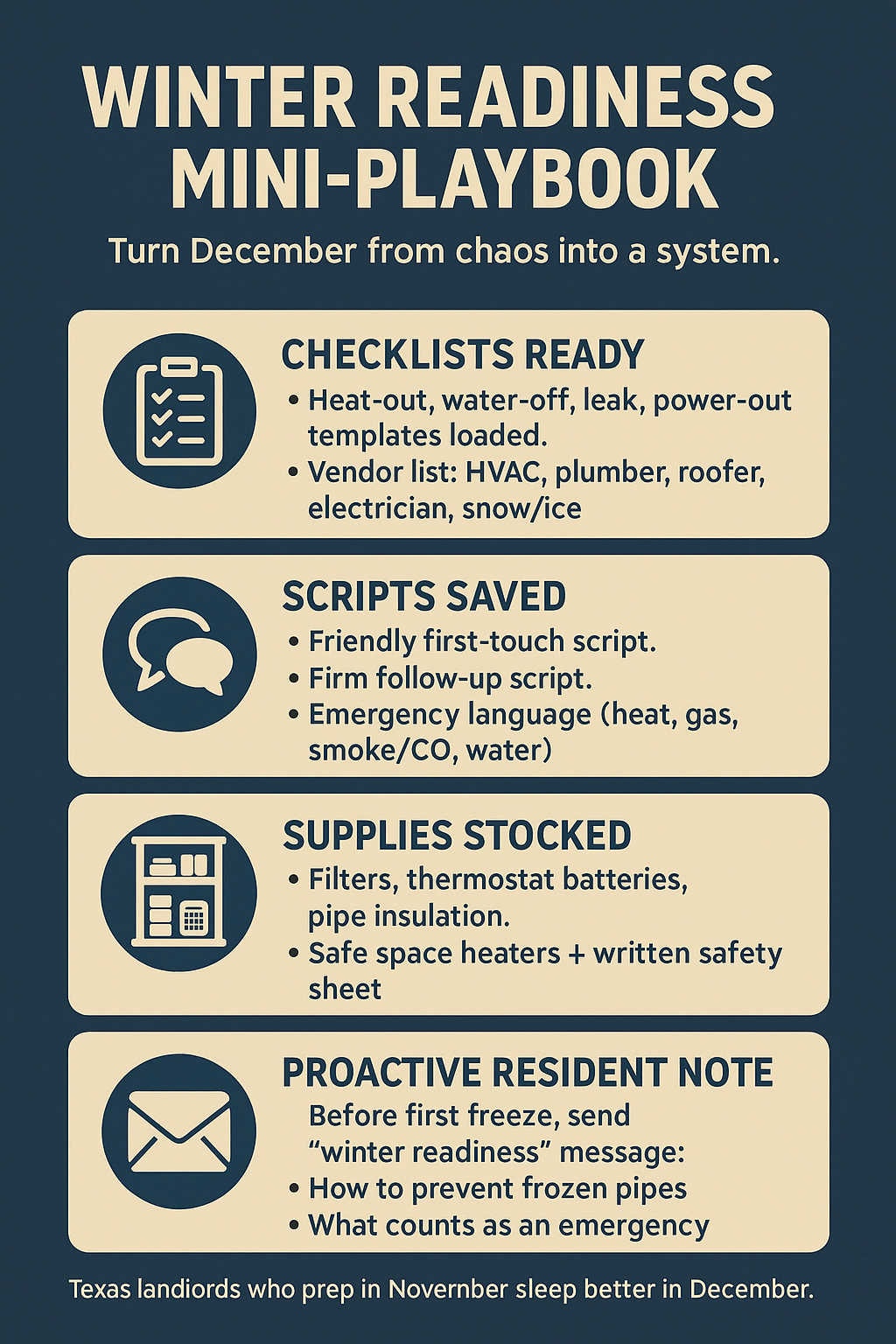
Your December Mini-Playbook
- Checklists ready: Heat-out, water-off, leak, power-out.
- Scripts saved: Friendly first touch, firm follow-up, clear escalation.
- Stocked supplies: Filters, thermostat batteries, pipe insulation, a few safe space heaters (with a written safety sheet).
- Proactive note: Before the first real freeze, send a “winter readiness” message: how to prevent frozen pipes, what counts as an emergency, how to reach you after hours.
Handle the patterns; don’t chase the chaos. A calm voice, a clear process, and a few smart habits turn December from a scramble into a system.


