

This Content Is Only For Subscribers
If you’ve managed rentals for a while, you know December has a split personality. It’s festive and frantic, generous and distracted. Even reliable tenants can get knocked off schedule by reduced work hours, bank holidays, weather, travel, or overspending. The question is how to respond—firmly enough to protect your cash flow, but humanely enough to preserve the relationship.
Here’s a practical playbook you can use each December (and, honestly, year-round).
1) Set Expectations Before December
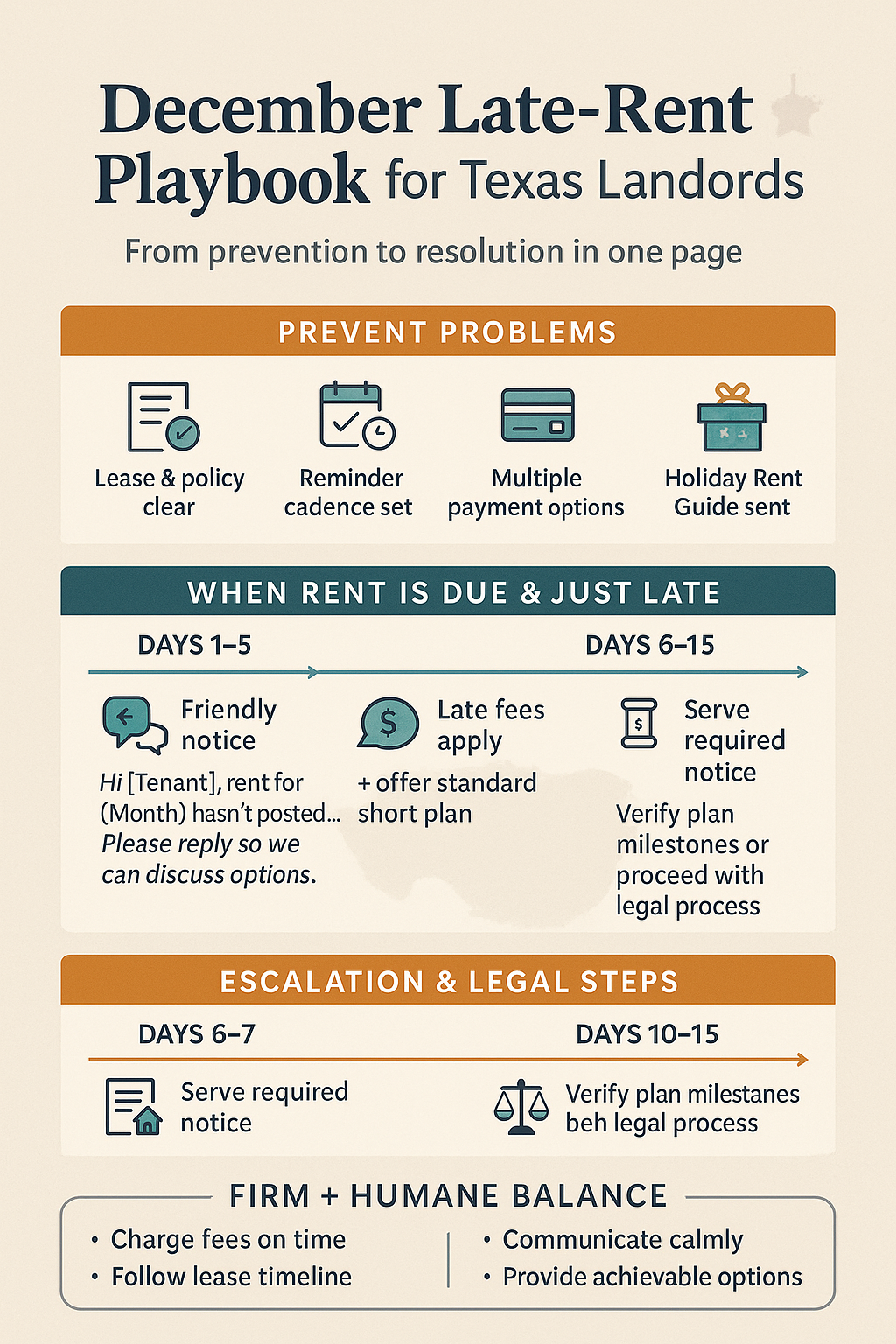
Put your policy in writing. Keep it clear and easy to find: due date and time, grace period (if any), late fee amount and trigger date, whether partials are accepted, accepted payment methods, and the sequence after 5, 10, and 15 days past due. Make sure the lease language specifies whether rent is considered paid when received or when sent—that detail matters around bank holidays.
Use a reminder cadence. Automated nudges three days before the due date, on the due date, and the day after cut down on avoidable lateness. Consider an additional mid-month “look-ahead” in December that explicitly calls out banking delays.
Offer multiple payment rails. Provide at least two digital options (ACH and debit/credit). If you accept checks, publish holiday office hours and drop-box details so bank and mail closures don’t become excuses. If your portal allows it, enable autopay to process one or two days early during holiday weeks.
Share a one-page “Holiday Rent Guide.” Tenants appreciate clarity. Include office closures, contact numbers, acceptable payment methods, and a bolded note: “Payments initiated Dec. 31 may post Jan. 2–3. Submit by Dec. 30 to ensure on-time receipt.”
2) When Rent Is Late: Lead With Process
Don’t take it personally; follow your steps.
- Verify facts. Check the ledger and any “processing” statuses.
- Send a friendly notice immediately. Day 2–3 is professional, not pushy.
- Hold your timeline. Apply fees when policy says to, unless a documented exception applies.
- Document everything. Emails, texts, portal screenshots, phone notes—keep a clean trail.
Friendly Late Notice (Day 2–3)
Hi [Tenant], this is [Your Name] with [Property/Company]. We don’t see the [Month] rent yet. Please submit today via [method] to avoid additional fees. If there’s a delay, reply so we can talk options. Thanks!
Why tone matters: You’re communicating two truths at once: rent is due, and you’re approachable. People mirror the energy you send; calm professionalism invites resolution.
3) December Curveballs to Anticipate
- Bank holidays & lags. Payments initiated Dec. 31 may not post until Jan. 2–3. Say “received by,” not “sent by,” and communicate the difference.
- Weather disruptions. Storms can stall jobs, mail, and offices—know how your policy treats force majeure.
- Irregular schedules. Retail/service shifts and bonuses don’t always pay out when expected. Ask for realistic timing, not best-case hopes.
- Travel complications. People out of town may forget physical checks or 2FA devices needed to access bank apps. Offer backup methods.
4) Flexibility—With Guardrails
Flexibility is a structured way to keep good tenants on track, not a free-for-all.
Waiver rules:
- One courtesy late-fee waiver per rolling 12 months for otherwise on-time tenants.
- No waiver if there’s an unpaid balance, repeated lateness, or a broken plan.
- Ask for documentation for additional consideration.
Payment plan templates:
- 48-Hour Catch-Up: Full balance within 48 hours.
- Split (Short Term): 50% by [date], 50% by [date + 7 days]; one fee.
- Holiday Bridge: 25% now, 25% in 7 days, 50% by the 15th with a signed addendum.
Tie any partial payment to a signed plan. Avoid the “rolling partial” trap where the balance lingers and your leverage erodes.
How to present options without negotiating against yourself:
“We have three standard options. Pick the one you can confidently meet. If none fit, we’ll follow the lease timeline.”
5) Scripts That Keep Things Calm
Reality Check + Options (Day 3–5)
“Hi [Name], rent for [Month] hasn’t posted. Holidays and bank closures can cause delays. When can you pay? If you’ll be past [date], we can discuss a short plan. I can email the options.”
Firm But Humane (Day 7–10)
“As of today, the balance is $[amount]. Per the lease, payment is due by [date]. If we don’t hear from you, the next step is a formal notice. I’d like to prevent that—can you confirm your plan by [time]?”
Resolution Note
“Thanks for catching up. Next December, consider submitting a day or two early due to bank holidays. I can help set up autopay.”
Boundary language when a plan is missed
“Because the [date] milestone wasn’t met, the payment plan is void. We’ll proceed per the lease. If you can pay the full balance today, please confirm and we’ll pause next steps.”
6) Legal Steps and Timelines
- Use the correct notice on time. If your process says Day 6 for pay-or-quit (or local equivalent), do it on Day 6—no empty threats.
- Calculate fees precisely. Follow lease and local caps; avoid “piling on” fees not allowed by statute.
- Know the effect of partial payments. In some jurisdictions, accepting partials after notice affects your ability to proceed—get attorney guidance.
- Watch closures. Court and office holidays can shift filing dates; document any delay.
- Annual tune-up. Have your attorney review your forms each fall so you start December with compliant paperwork.
7) Protect Cash Flow Without Burning Goodwill
Build a December cushion. Reserve at least one month of essential property expenses (mortgage, taxes, insurance, utilities) so a few late payers don’t rattle operations.
Forecast realistically. If history shows 96% collection by the 10th, plan to that—not to the 1st. A realistic budget prevents panic concessions that you’ll regret in January.
Consider an on-time discount. If permitted, structure the legal rent at X with an on-time reduction to Y. Execute consistently and put it in the lease; do not improvise midstream.
Avoid negotiating against yourself. If you waive a fee, do it once, document the reason, and pair it with a behavior change (autopay, early-pay commitment, or a signed plan).
Pro tip: “Collections math” check.
- Waiving a $75 late fee might save a $350 filing fee and a vacant month if goodwill keeps a solid tenant.
- But waiving repeatedly for a habitually late tenant can cost thousands over a year. Use data, not vibes.
8) Tech and Habits That Reduce Late Payments
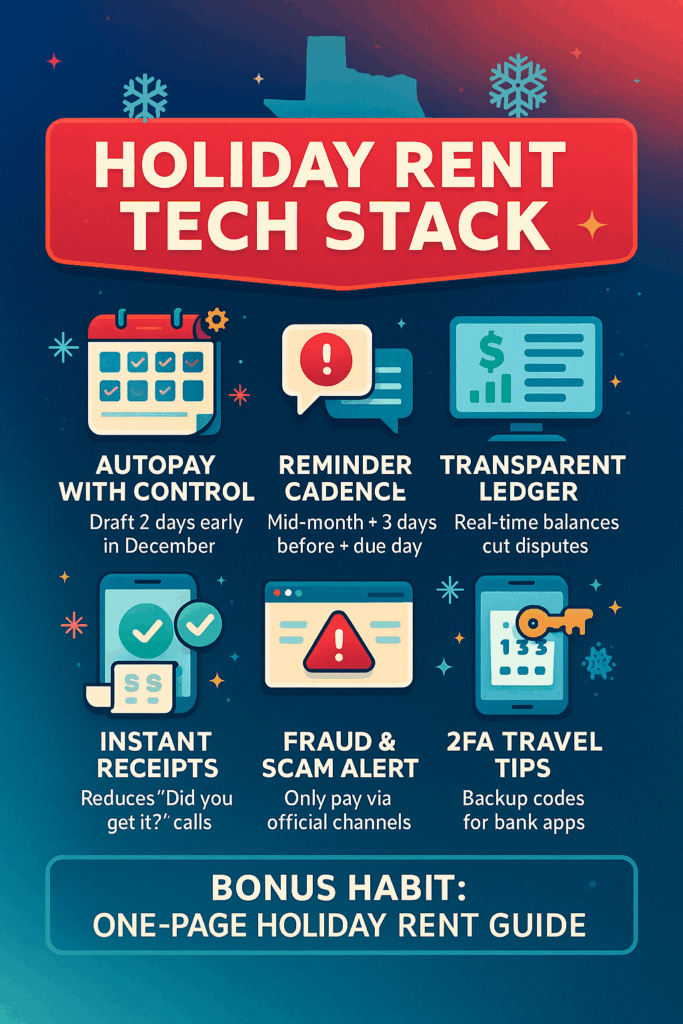
- Autopay with control. Allow drafts two days before due dates in December.
- Multiple reminders. A mid-month “look-ahead,” a three-day pre-due note, and a due-day reminder.
- Transparent ledgers. Real-time balances reduce disputes and “I thought I paid” claims.
- Receipts. Instant “payment received” messages calm nerves and cut follow-ups.
- Fraud awareness. Remind tenants of official channels; scams spike during the holidays.
- Two-step verification tips. Provide a quick guide for tenants traveling who might need backup codes to access bank apps.
9) When Hardship Is Real
You can be compassionate without running a social service agency.
- Verify. Ask for documentation (layoff notice, reduced hours, medical billing).
- Provide resources. Share legitimate local aid links and the documents they’ll need.
- Time-bound plans. “We’ll check status on the 7th and 14th; if aid isn’t confirmed by the 15th, lease timelines proceed.”
- Hold non-negotiables. Safety and quiet enjoyment for other residents still apply.
Phrase that balances empathy and boundaries:
“I hear what you’re dealing with, and I’m sorry you’re going through it. Here’s what our policy allows so we can keep your housing stable while staying fair to everyone.”
10) Coordinate Your Team (Even If It’s Just You)
Write a simple playbook:
- Who checks payments and when (daily by 10 a.m.).
- Who sends which notice (friendly reminder vs. formal).
- Fee decision criteria and approvals.
- After-hours call handling and escalation.
- Where documentation lives (PM software or a shared folder).
Internal “holiday huddle.” Schedule a 20-minute team check-in the last week of November: confirm scripts, update holiday hours, and rehearse edge cases (bank closures, snow days, portal outages).
11) Common December Missteps (and Fixes)
Waiting too long. Calendar your steps; Day 3 means Day 3.
Over-promising flexibility. Offer only what your policy allows; “Let me confirm and email the plan” buys thinking time.
Uneven fee waivers. One courtesy, same criteria for all.
Endless partials. Require a signed plan tied to each partial.
Messy records. Log calls, save texts, screenshot ledgers.
Ignoring bank holidays. Proactively warn: “Payments initiated Dec. 31 may post Jan. 2–3; submit by Dec. 30.”
12) A Practical Timeline
Dec 20–23:
- Send a “holiday schedule” notice (office hours, payment methods, portal links, and how bank holidays affect processing).
- Encourage early submission or autopay.
Dec 28–30:
- Send a final reminder: “To avoid holiday delays, submit by Dec. 30.”
Due Date / Jan 1:
- Send receipts and reconcile ledgers. Trigger reminders for any balances.
Day 2–3:
- Friendly late notice; invite conversation.
Day 4–5:
- Apply late fees. Offer a standard short payment plan; get signatures.
Day 6–7:
- If no progress, serve the required notice. Keep documenting.
Day 10–15:
- Verify plan milestones or proceed with legal timelines while accepting a full cure if permitted.
13) Language That Lowers the Temperature
- Instead of: “You’re late again.”
Use: “Our records show [Month] rent hasn’t posted yet.” - Instead of: “Pay or we’ll evict you.”
Use: “If payment isn’t received by [date], we’ll need to send a formal notice per the lease.” - Instead of: “That’s your problem.”
Use: “Here’s what we can do within our policy.” - Instead of: “I’m making an exception just for you.”
Use: “Our policy includes a one-time courtesy waiver. I’ve applied that today.”
Neutral, specific language keeps relationships intact and reduces disputes.
14) Train Tenants for Next Year
In January, invest 30 minutes to prevent repeats:
- Send a thank-you + tips note; reiterate the policy.
- Offer autopay setup help, even a quick phone walk-through.
- Review which reminders worked best and double down on them.
- Update your one-page “Holiday Rent Guide” while the season is fresh in mind.
Quick follow-up template:
“Thanks for navigating the holiday rush with us. To help next year: (1) enable autopay, (2) submit by the 30th in December, (3) keep our payment links handy. Reply ‘SETUP’ if you’d like help enrolling in autopay.”
15) Mini Case Studies (What Works)
Case 1: The Bonus That Arrived Late
A reliable tenant expected a Dec. 20th bonus; it landed Jan. 3rd. We used the Holiday Bridge plan: 25% on Dec. 29, 25% Jan. 5, 50% Jan. 15. Late fee applied once; tenant stayed current the rest of the year. Lesson: attach partials to a written plan with real dates.
Case 2: Storm Delays + Traveling Tenant
Tenant traveled and couldn’t access bank 2FA. We offered a backup method and a 48-Hour Catch-Up. Payment cleared; we sent a January tip about saving backup codes. Lesson: provide contingency channels before problems happen.
Case 3: Habitual Late Payer
Three late payments in six months, two broken plans. We followed the timeline, issued notice on Day 6, and required full cure. They paid in full, then set up autopay to avoid future fees. Lesson: consistency trains behavior.
16) The Balanced Approach
You run a business—and you house people. December will test both truths. Let the lease and your process carry the weight while you bring clarity and seasonal grace:
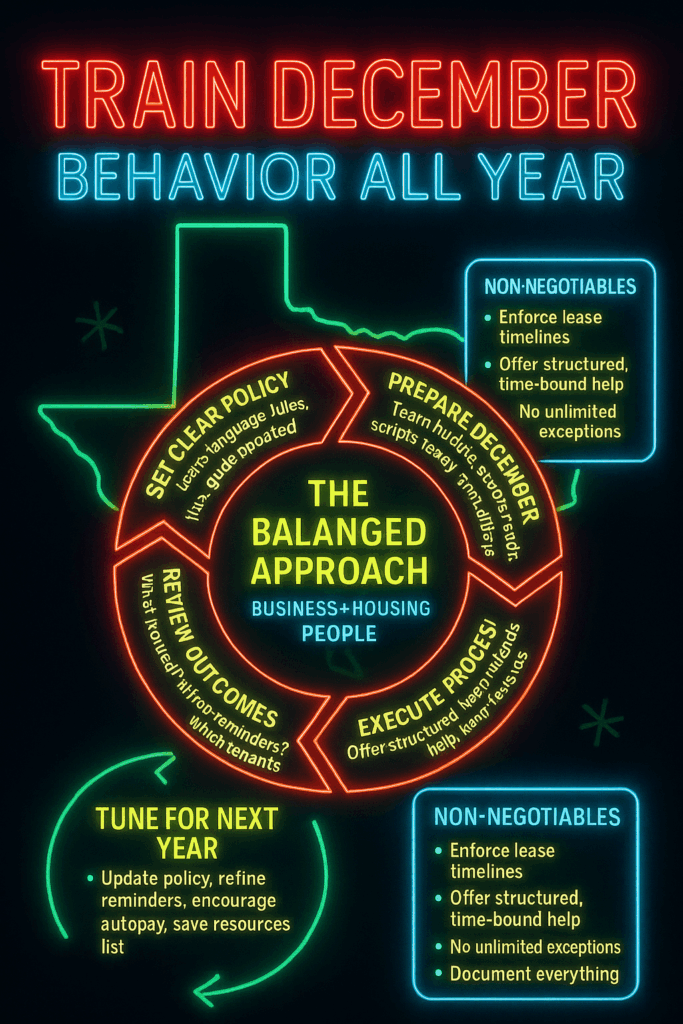
- Enforce the policy on schedule.
- Offer structured help for genuine hardship.
- Keep boundaries—no unlimited exceptions.
- Communicate respectfully and keep excellent records.
Do this, and you’ll finish the holidays with steady cash flow, a strong reputation, and fewer fires to put out—ready to start the new year on solid ground.


