

This Content Is Only For Subscribers
An expense is money you spend. An investment is capital you deploy to generate a return. The fundamental distinction between a casual landlord and a serious real estate investor lies in the understanding of that single sentence. A landlord paints a wall because it’s scuffed; an investor paints a wall because a $200 outlay can increase the perceived value of the space, reduce vacancy time by a week, and protect the underlying asset. Every decision is filtered through the lens of Return on Investment (ROI).
Welcome to Investor Corner, a new column dedicated to the business of real estate. We’re not here to talk about the color of the year or the latest design fads. We’re here to talk about numbers. We’re here to analyze how to deploy capital into your rental properties to maximize cash flow, increase Net Operating Income (NOI), and drive long-term appreciation. And with the peak Texas leasing season upon us, the single most important question an investor can ask is: where should I invest my capital right now for the greatest possible return this summer?
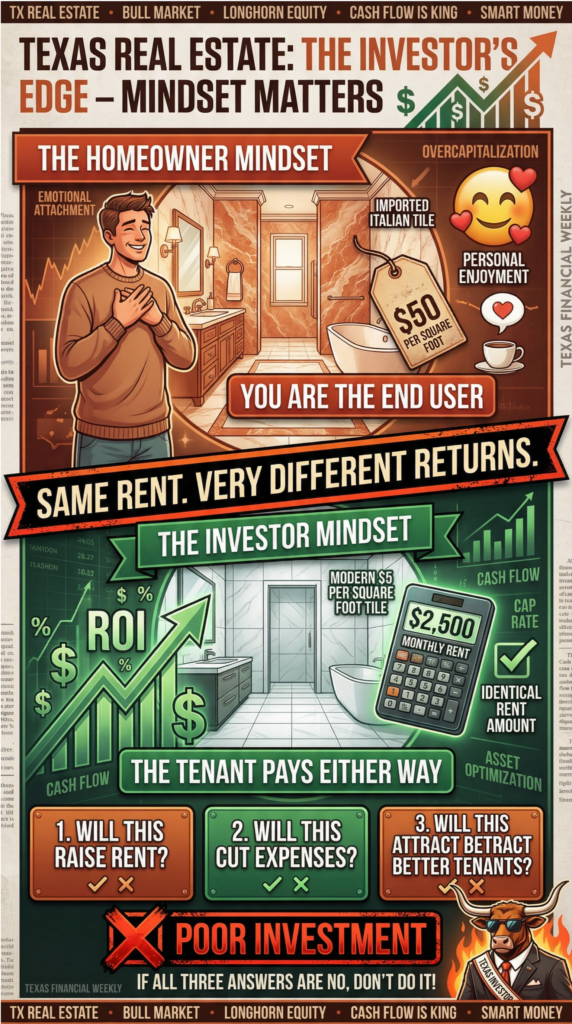
The Homeowner Mindset vs. The Investor Mindset
Before we talk about specific upgrades, we must address the most common mistake landlords make: applying a homeowner’s mindset to an investment property. A homeowner might install a high-end, imported Italian tile in their bathroom because they love the way it looks. They are the end user, and the return is their personal enjoyment. An investor understands that a clean, modern, and durable $5-per-square-foot tile will likely generate the exact same rent as a $50-per-square-foot tile. The additional $45 per square foot is not an investment; it’s a donation to the tenant’s aesthetic sensibilities.
Your objective is not to create your personal dream home. Your objective is to create a safe, clean, and desirable product for a specific rental market, at a price point that maximizes your return. Every upgrade must be evaluated against three core questions:
1.Will this allow me to increase the rent?
2.Will this decrease my operating expenses?
3.Will this attract a higher quality tenant and/or reduce vacancy?
If the answer to all three is “no,” the upgrade is likely a poor investment.
High-ROI Upgrades for the Texas Summer Market
In the Texas summer, tenant priorities are clear: they want to be cool, they want their utility bills to be manageable, and they want to enjoy the long evenings. Your investment strategy should align directly with these market demands.
Category 1: The NOI Boosters (Expense Reduction)
These upgrades may not always allow you to charge dramatically more rent, but they directly increase your NOI by lowering your property’s operating costs. A dollar saved in expenses is a dollar added directly to your bottom line, which in turn increases the cap rate valuation of your property.
•High-Efficiency HVAC Systems: If your property has an HVAC system that is more than 12-15 years old, it is an operational liability. Replacing it with a modern, high-efficiency unit (16 SEER or higher) is one of the most powerful investments you can make. It reduces the likelihood of a costly and tenant-infuriating mid-summer failure, and a lower average utility bill is a powerful marketing tool.
•Smart Thermostats: For a relatively low cost (typically under $200), a smart thermostat like a Nest or Ecobee offers a dual return. It provides a tangible tech amenity that tenants appreciate, and it can significantly lower cooling costs, whether you pay the utilities or your tenant does. If the tenant pays, it becomes a marketable feature that reduces their total cost of living in your property.
•Ceiling Fans: In Texas, a ceiling fan in every bedroom and living room is not a luxury; it’s a baseline expectation. If a room is missing one, adding it is a high-impact, low-cost upgrade that improves tenant comfort and can reduce A/C usage.
Category 2: The Rent Drivers (Income Generation)
These are the upgrades that directly enhance the perceived value and livability of the property, giving you the leverage to command a higher rent. These investments are about creating a superior product that stands out in a crowded market. This is where you can find specific Upgrades That Boost Rent in Competitive Markets.
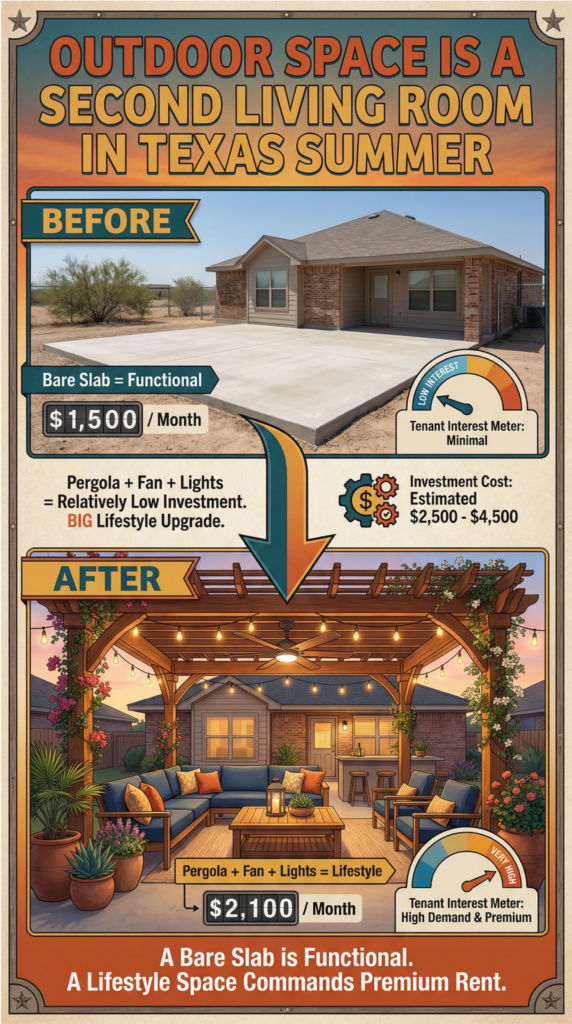
•Outdoor Living Spaces: In the summer, outdoor space is a second living room. A bare concrete slab is functional; a concrete slab with a simple pergola for shade, a ceiling fan, and some string lights is a lifestyle. This is a relatively low-cost addition that can dramatically increase the appeal of your property. For multi-family properties, upgrading a common-area patio with better seating, shade, and a well-maintained grill can be a significant differentiator.
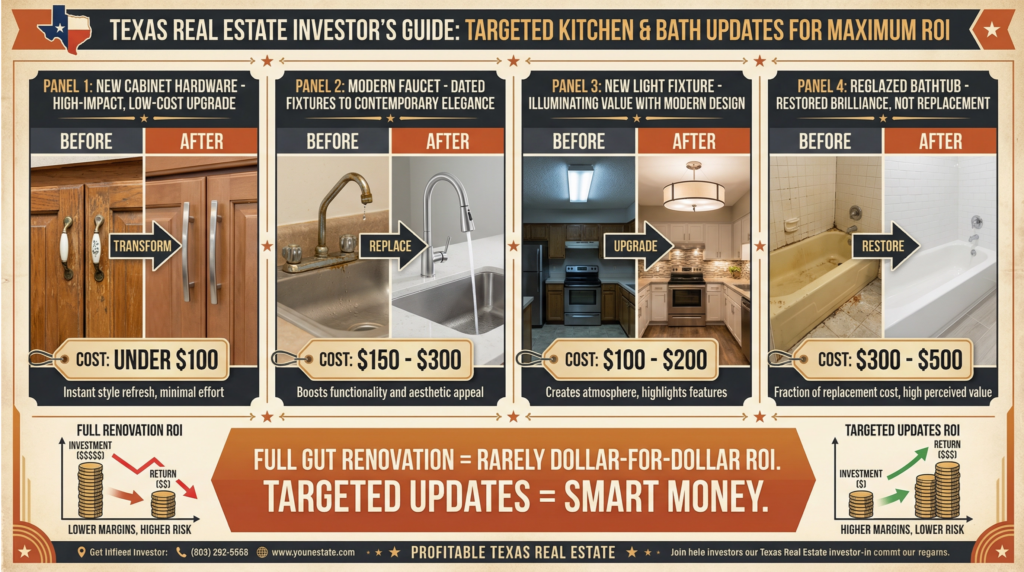
•Targeted Kitchen and Bath Updates: Full gut renovations rarely provide a dollar-for-dollar ROI in a rental. The key is to focus on the ROI on Minor Renovations Before Peak Season. This means focusing on high-impact, low-cost items. Think new cabinet hardware, replacing a dated faucet, installing a modern light fixture, or reglazing a tired-looking bathtub. These small touches can make a kitchen or bath feel fresh and updated for a fraction of the cost of a full remodel.
•Strategic Flooring Upgrades: Old, stained carpet is the single fastest way to make a property feel dated and unclean. While it may seem like a major expense, replacing worn-out carpet with modern Luxury Vinyl Plank (LVP) flooring is a strategic move with a multi-faceted return. LVP is incredibly durable, waterproof, and easy for tenants to clean, which reduces your turnover costs and extends the life of the finish. Aesthetically, it instantly modernizes a space, providing a clean, continuous look that makes rooms feel larger and more upscale. This is a capital-intensive upgrade, but the combination of higher rent, lower maintenance, and increased tenant appeal often provides a compelling ROI.
The Strategic Framework
Making the decision to upgrade is only the first step. A true investor embeds that decision in a broader strategic framework.
First, your pricing must be informed by data. Before setting a post-upgrade rent, you must be Using Summer Market Data to Inform Pricing Strategy. What are comparable, recently-upgraded units in your submarket renting for? If your upgrades don’t align with what the market is willing to pay, you have over-invested.
Second, the execution must be timed to perfection. A two-week renovation that causes an extra month of vacancy can wipe out the entire year’s return on the investment. This requires careful Planning Renovations to Minimize Vacancy, scheduling the work to happen in the tightest possible window between tenants.
Ultimately, every capital deployment decision should be run through a simple ROI calculation. If you spend $5,000 on upgrades and it allows you to confidently increase the rent by $100 per month, that’s a $1,200 annual return on a $5,000 investment—a 24% cash-on-cash return. That’s a number that speaks for itself. That is the language of the investor.


