

This Content Is Only For Subscribers
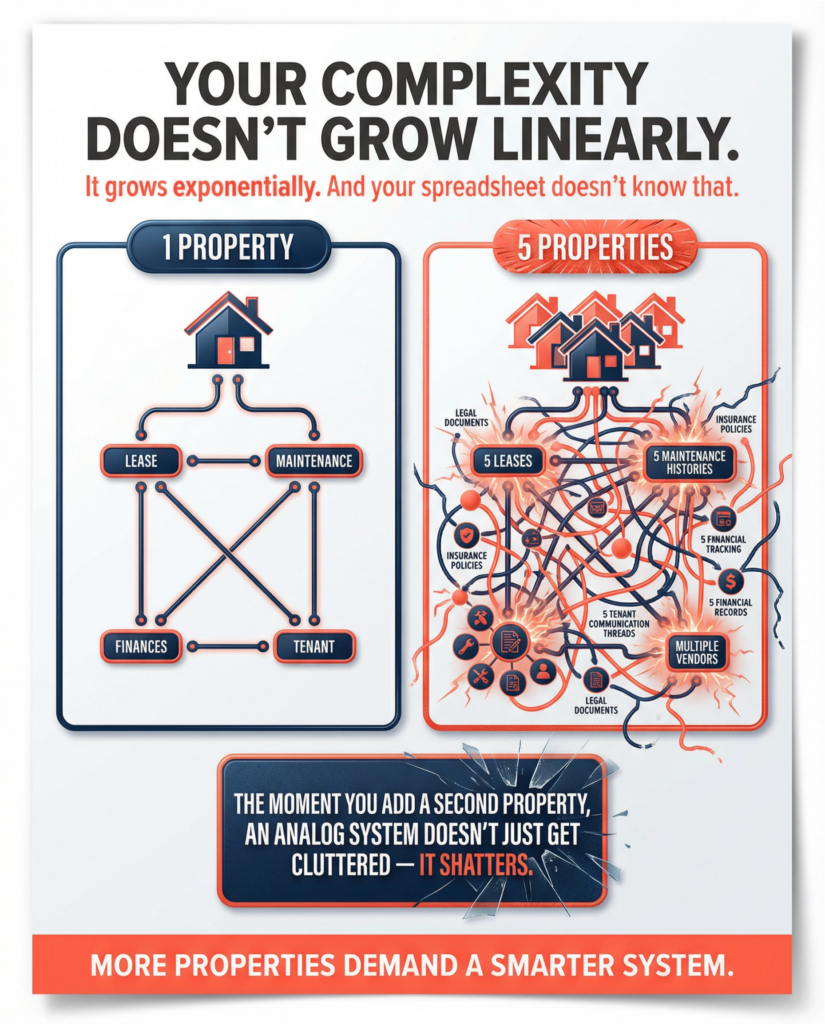
For the landlord with a single property, a simple task manager or a well-organized spreadsheet can work. It’s manageable. But the moment you add a second, third, or fifth property to your portfolio, that analog system doesn’t just become cluttered; it shatters. The complexity of your business doesn’t grow linearly; it grows exponentially. You now have multiple leases expiring at different times, separate maintenance histories, and distinct financial records. Trying to manage this with disconnected tools is a direct path to burnout.
The Curse of Information Silos
The core problem with scaling a real estate portfolio using basic tools is the creation of information silos. You have one spreadsheet for tracking rent payments, another for maintenance expenses, and a folder on your computer with lease documents. Your tenant communication is scattered across text messages and emails. To get a complete picture of your business, you have to manually pull data from five different places. This makes it nearly impossible to answer fundamental questions like, “Which of my properties is actually the most profitable?” or “What is my total maintenance spend across my entire portfolio for the last quarter?”
The Solution: A Single Pane of Glass
This is where a true property management platform becomes not just a nice-to-have, but an absolute necessity. The central promise of these platforms is the elimination of information silos. They provide a “single pane of glass”—one unified dashboard where you can see everything about your entire portfolio, and then drill down into the details of a single property with a single click. This is the leap from being a landlord who owns multiple properties to an investor who manages a portfolio.
Here are the killer features that make this possible:
•The Portfolio Dashboard: This is your 30,000-foot view. When you log in, you don’t see a list of tasks; you see the vital signs of your entire business. At a glance, you can see your total occupancy rate, how many leases are expiring in the next 60 days, your collective rent roll, and any open maintenance requests across all properties. It’s a real-time snapshot of your entire operation.
•Granular, Property-Level Drill-Down: From the portfolio dashboard, you can click on any individual property (e.g., “123 Main Street”) and instantly see its specific dashboard. Now you’re looking at the lease details for that tenant, the complete maintenance history for that unit, and its individual profit and loss statement. All the data is interconnected.
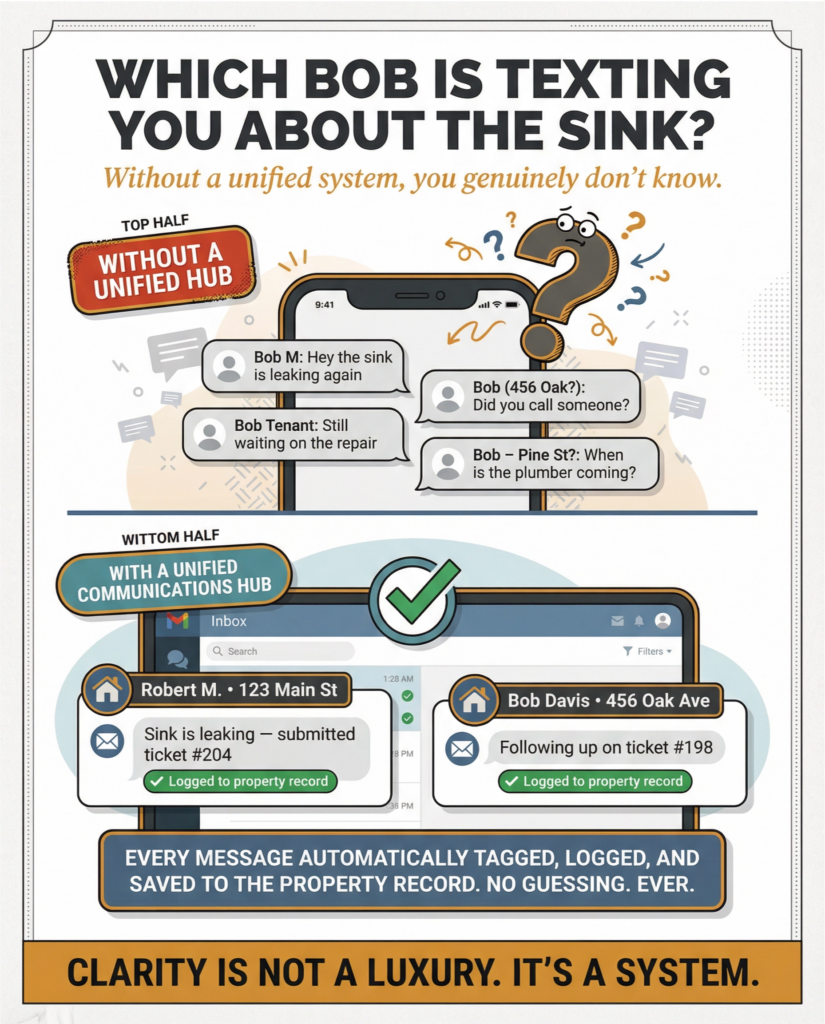
•Unified Communications Hub: Instead of a chaotic inbox, these platforms provide a unified messaging center. When a tenant from 456 Oak Avenue sends a message through their portal, it arrives in your inbox clearly tagged with their name and property address. You can respond, and the entire conversation is automatically logged and saved to that property’s record. No more guessing which “Bob” is texting you about a leaky sink.
•Global and Specific Financial Reporting: This is where these platforms truly earn their keep. You can run financial reports at any level. Need to see your total income and expenses for your entire portfolio for tax season? Two clicks. Need to see if the rent increase at 789 Pine Street covered the cost of the new water heater? Drill down to that property’s P&L statement. This level of financial clarity is impossible with a collection of spreadsheets.
Unlocking True Scalability
The platforms that deliver this integrated experience are the all-in-one property management software suites we’ve discussed, like AppFolio, Buildium, and Stessa. They are built from the ground up on the principle of portfolio management. They understand that a landlord with ten properties has a fundamentally different set of challenges than a landlord with one.
Adopting a platform that can track multiple properties is the single most important step you can take to prepare your business for growth. It allows you to add new properties to your portfolio without exponentially increasing your administrative workload. It provides the data-driven insights you need to make smart investment decisions. It professionalizes your operation, reduces your legal risk, and frees you from the tyranny of scattered information. It’s the technology that finally allows you to stop working in your business and start working on it.


