

This Content Is Only For Subscribers
If you’re a Texas landlord heading into 2026 with a five-year-old lease template and “we’ve always done it this way” as your legal strategy… I’m going to lovingly suggest: don’t.
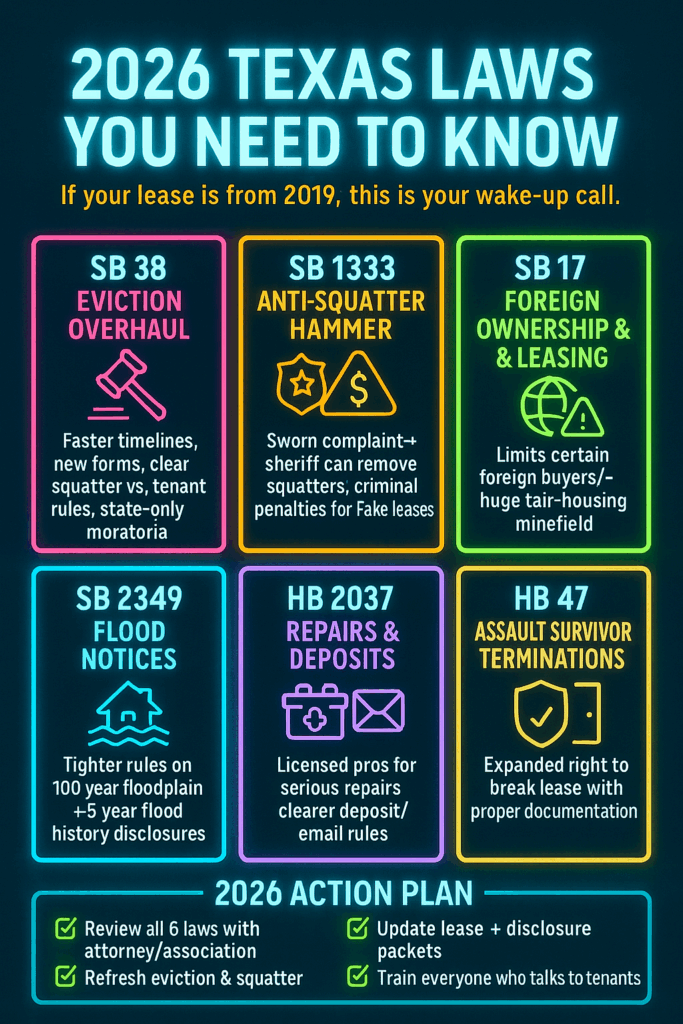
The 89th Legislature dropped a whole batch of laws that either just took effect on September 1, 2025 or kick in January 1, 2026. Several of them directly change how you evict, disclose, repair, and communicate with tenants.
Here’s the law-school-free version of what you actually need to know.
1. SB 38 – The Big Eviction Overhaul (Effective Jan. 1, 2026)
SB 38 is the star of the show. Signed in June 2025, it rewrites key parts of Texas eviction law and applies to cases filed on or after January 1, 2026.
Highlights for landlords:
- Faster timelines: Justice courts must move cases more quickly, with tighter windows for hearings and service of writs. In some counties, constables now have as little as five days to act before other officers can be used.
- Squatter clarity: The law clarifies venue and procedure for removing people who were never entitled to be there, tightening up what courts can look at in an eviction case.
- Moratorium power: Only the state legislature can change eviction procedures or impose moratoria, shutting the door on local governments improvising their own bans in a crisis.
What this means for you:
- Your notices, petitions, and timelines for 2026 evictions cannot be copy-pasted from 2024 forms.
- If you or your manager routinely file evictions, you want a walk-through with your attorney or association on exactly how your workflow must change.
2. SB 1333 – The Anti-Squatter Hammer (Effective Sept. 1, 2025)
If SB 38 reshapes the court side, SB 1333 gives you a law-enforcement-led shortcut when you’re dealing with true squatters. It’s aimed at unauthorized occupants and fake leases.
Key pieces:
- Lets owners file a sworn complaint with law enforcement when someone is occupying their dwelling without any legal right.
- Authorizes sheriffs/constables to verify ownership and order squatters out without you filing a full eviction case first—if statutory conditions are met.
- Creates new criminal offenses and stiffer penalties for fraudulent leasing, advertising, or “selling” property you don’t own.
What to do:
- Keep proof of ownership easy to grab (deed, ID, entity docs).
- If someone occupies your unit without a real lease, call a lawyer and law enforcement, don’t improvise. The line between “squatter” and “tenant with a bad story” matters a lot under these laws.
3. SB 17 – Foreign Ownership & Some Lease Headaches (Effective Sept. 1, 2025)
SB 17 restricts who can buy or acquire interests in Texas real property if they’re tied to certain foreign governments (notably China, Russia, Iran, and North Korea) or designated entities.
Complications for landlords:
- The law reaches some leasing situations, especially longer-term interests; and there’s already active litigation arguing it’s unconstitutional and discriminatory.
- It’s not written as a clean “do X / don’t do Y” guide for small landlords. How it will be enforced around residential leases is still being fought out in court and guidance memos.
Practical approach:
- Don’t build a DIY screening policy around passports or national origin—that’s how you trip Fair Housing wires.
- If your portfolio routinely rents to foreign nationals, talk with a Texas real estate or fair-housing attorney about how to comply with SB 17 without discriminating.
4. SB 2349 – Floodplain & Flood History Notices (Effective Sept. 1, 2025)
Texas already required landlords to tell tenants if a dwelling is in a 100-year floodplain or has flooded in the last five years. SB 2349 mostly cleans up the gray areas and short-term exceptions.
Key clarifications:
- Short-term leases under 30 days and certain temporary leasebacks up to 90 days no longer require the standard flood notices.
- Everyone else? Still on the hook for written flood disclosures.
Your move:
- For each property, confirm floodplain status and keep flood history notes.
- Bake a flood disclosure form into every standard lease package unless you fall squarely into the short-term exemptions.
5. HB 2037 – Repairs & Security Deposits (Effective Sept. 1, 2025)
HB 2037 quietly updates two practical areas: “repair and deduct” situations and security deposit notices.
In plain English:
- When a tenant properly invokes the notice-to-repair process, qualifying repairs must be done by an independent, appropriately licensed contractor (where licensing is required)—not your unlicensed buddy.
- For security deposits, the law clarifies notice and refund procedures and explicitly allows using email for certain communications if that’s an established channel with the tenant.
What to fix in your operation:
- Build a list of licensed pros for HVAC, plumbing, electrical, etc.
- Decide whether you want to standardize email as your official notice method—and then be consistent.
6. HB 47 – Expanded Lease Termination Rights for Assault Survivors (Effective Sept. 1, 2025)
HB 47 extends protections for tenants who are survivors of sexual assault and related offenses. Under this update, they can terminate a lease even if the assault did not occur at the property, as long as they provide the documentation the statute requires.
For landlords, the key is handling these requests correctly and respectfully:
- Have a written internal procedure: who reviews the request, what documentation is required by Property Code, and how you respond.
- Train staff not to argue about the facts of the assault or improvise new requirements in emails.
Turning This Into an Action Plan
To keep yourself out of trouble in 2026:
- Sit down with counsel or your local association and walk through SB 38, SB 1333, SB 17, SB 2349, HB 2037, and HB 47 as they relate to your properties.
- Update your lease package:
Flood disclosures
Repair/notice language
Security-deposit and email-communication clauses
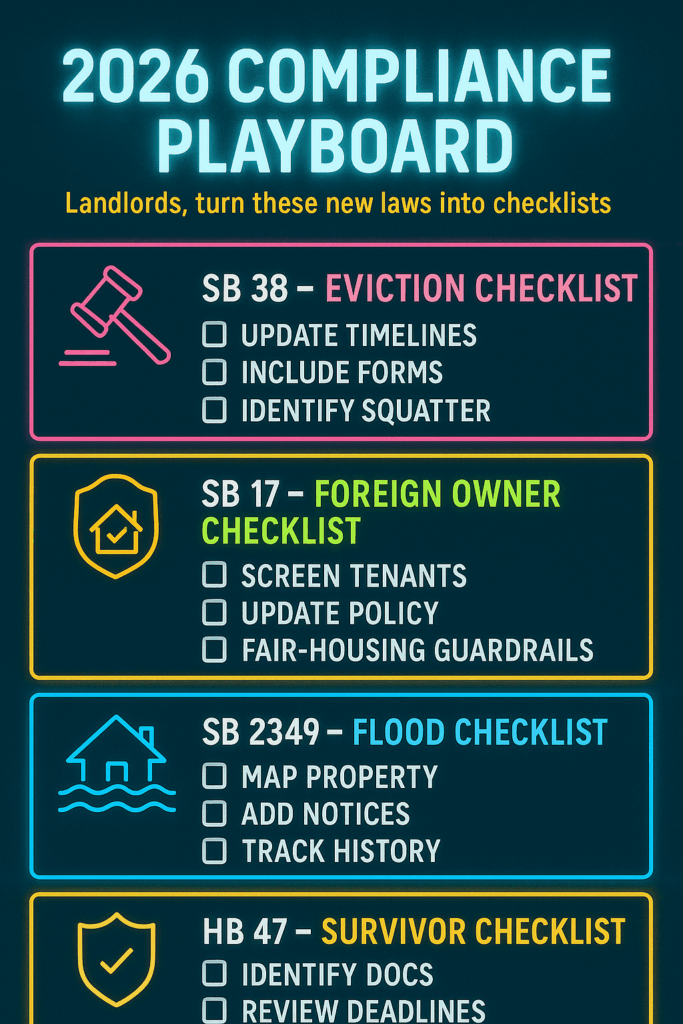
- Refresh your eviction and “squatter” playbooks for the new timelines and law-enforcement options.
- Train anyone who talks to tenants on the new rules—especially around repairs, early terminations, and safety-sensitive situations.
And remember: this is a roadmap, not legal advice. When the stakes are high, a one-hour conversation with a Texas landlord-tenant attorney is a lot cheaper than learning these laws from the wrong side of a courtroom.


