

This Content Is Only For Subscribers
Cold snaps don’t respect out-of-office replies. If a front hits while residents are out of town, a frozen line can silently become a burst—and you might not hear about it until the neighbors text a video. Here’s a concise, Texas-savvy plan to keep pipes flowing when units sit empty over the holidays.
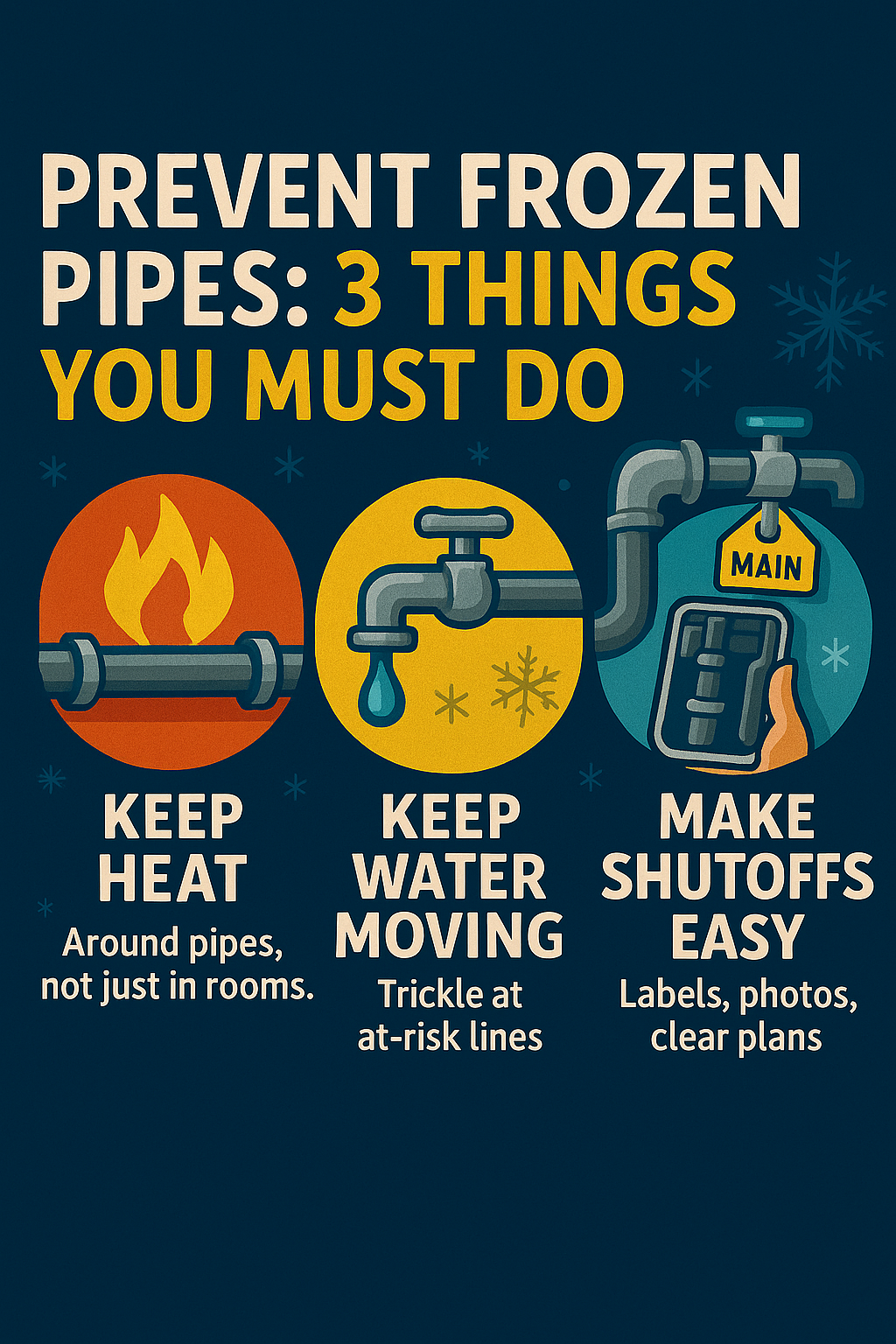
The three goals
- Keep heat around pipes (not just in rooms).
- Keep a trickle moving through at-risk lines.
- Make shutoffs easy if something goes wrong.
Do those three and you’ll avoid almost every freeze loss.
1) Prep the property before anyone leaves
Insulate and seal
Wrap exposed plumbing in garages, crawlspaces, and attics with foam sleeves; tape seams.
Install faucet/hose-bib covers and caulk the exterior bib flange to the wall.
Seal big air leaks near plumbing: cable/pipe penetrations, dryer vents, and gaps under exterior doors. Add door sweeps and weatherstripping.
Protect weak spots
Kitchens/baths on exterior walls: ensure under-sink holes are sealed with fire-block foam or backer rod + caulk; add easy-flip cabinet props for cold snaps.
Attic/chase lines: put pipes on the warm side of insulation; don’t bury them in loose fill.
Test and label
Thermostats: confirm heat mode, replace weak batteries, and verify auxiliary/EM heat on heat pumps.
Shutoffs: tag unit and fixture valves with bright labels; photograph locations for your resident guide.
Common-area checks
Laundry rooms: insulate supplies; add a low-watt, thermostat-controlled heater if temps dip.
Mechanical rooms: close louvers not needed for combustion air; eliminate drafts across domestic risers.
2) Give residents a simple travel checklist
Send this 48–72 hours before a predicted freeze (and again the day they depart):
Heat & airflow
Set heat to 68–70°F (don’t switch off).
Open under-sink cabinet doors on exterior walls.
Leave interior doors open so warm air reaches plumbing.
Water movement
Drip COLD water from at-risk faucets (steady pencil-thin stream).
Run the tub/shower furthest from the water heater at a slow drip, too.
Appliances & fixtures
Disconnect outdoor hoses; confirm hose-bib covers are on.
Verify refrigerator water lines aren’t pinched and ice-makers are off if water is shut at the saddle valve.
Contacts & access
Share travel dates and a reachable number.
Grant permission (in writing) for management to enter for emergencies and shut off water if needed.
If you allow main shutoff when tenants are away (policy-dependent), give exact steps and photos. Otherwise, make clear they should not close the main—just call you.
3) Smart thermostat and tech settings
Disable “eco” away modes that drop temps at night. Create a temporary schedule holding 68–70°F 24/7 while they’re gone.
If you use leak sensors, test batteries and confirm alerts go to a monitored inbox or phone.
4) What to do with vacant units
Set heat to 68°F and drip the farthest cold faucet.
Open cabinets, remove toe-kicks if possible to warm the cavity, and place a small temperature sensor under the sink.
Walk daily during freezes; use a moisture meter at known cold spots.
5) Irrigation, pools, and exterior lines
Irrigation: shut down controllers, isolate/back-drain the backflow preventer, and insulate it.
Exterior kitchens and hose spigots: insulate supply lines; cap with push-fit stop ends where seasonal lines are disconnected.
Pools/spas: confirm freeze protection and flow switches; maintain water levels so pumps don’t activate during power flickers.
6) Heat tape and recirculation (plan ahead)
Use UL-listed heat tape only on pre-identified runs, powered by GFCI, installed per manufacturer spacing—never as an emergency wrap at 11 p.m.
If the building has a domestic hot-water recirculation loop, verify pumps and timers run through cold nights.
7) Communication templates you can copy
Pre-travel message
Headed out for the holidays? A hard freeze is possible. Please set heat to 68–70°F, open under-sink cabinet doors on exterior walls, and drip cold water at at-risk faucets. If you see no water or any leak, text/call [number] immediately. Your water shutoff photo is here: [link].
During-freeze reminder
Freeze tonight/tomorrow. Keep heat at 68–70°F, continue cabinet doors open and drips running. If heat stops or you see moisture, contact [number]—we’re on call.
8) If something still freezes
No flow, no visible leak: warm the space; keep cabinets open and drips set; stand by with the smallest zone shutoff identified; do not re-pressurize unsupervised after thaw.
Active leak: shut the smallest zone (fixture → unit → stack), protect lower units, start drying (towels/wet vac), and dispatch plumber + mitigation in parallel.
Document with photos and note times; those details help insurance and your CPA.
9) Quick owner checklist (print and tape inside the maintenance room)
Insulate exposed runs; install hose-bib covers.
Tag/photograph shutoffs; upload to the resident portal.
Replace thermostat batteries; test aux/EM heat.
Send travel checklist 72 hours pre-freeze; resend day-of.
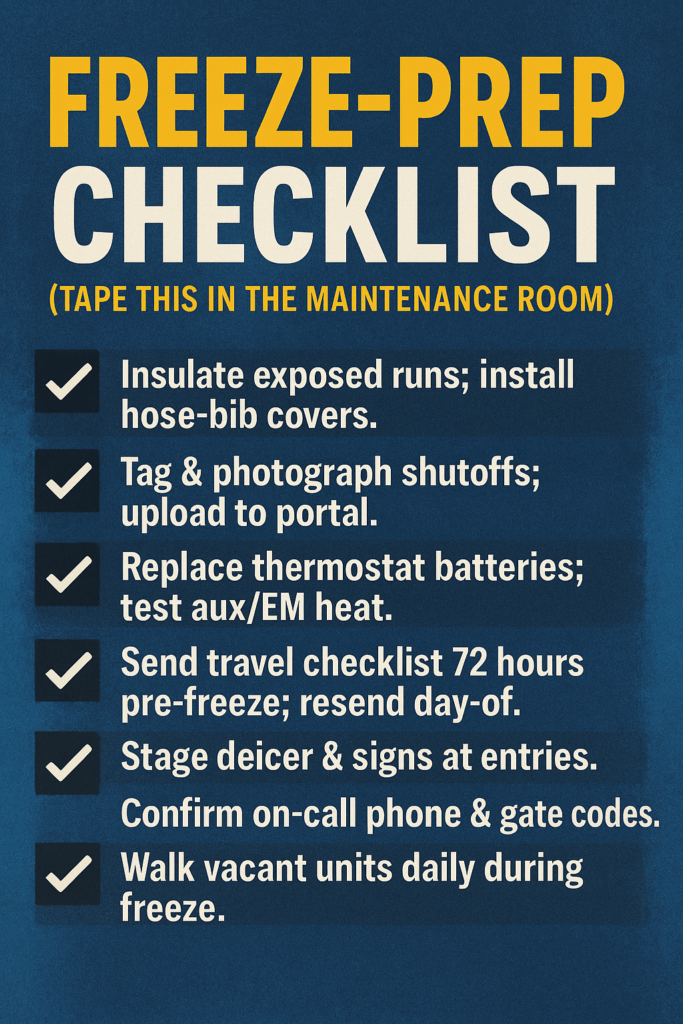
Stage deicer at entries; confirm on-call phone.
Walk vacant units daily during the event.
Bottom line
Preventing frozen pipes while residents travel isn’t about fancy gear—it’s airflow, a steady drip, sealed drafts, and clear shutoff plans. Prepare the building, hand tenants a two-minute playbook, and verify the weak spots. When a blue norther blows through while everyone’s at grandma’s, your pipes will keep doing what they’re supposed to do: quietly carry water, not headlines.


