

This Content Is Only For Subscribers
If you own rental property in Texas, you’ve probably heard the word depreciation tossed around at tax time. It’s one of those terms that gets mentioned with a mix of respect and confusion—because when used correctly, depreciation can be one of the most powerful tools landlords have for reducing taxable income. But when misapplied, it can lead to costly mistakes, IRS headaches, and even penalties.
The good news? With a clear understanding of how the IRS treats depreciation, you can maximize your deductions, stay compliant, and keep more of your rental income where it belongs—in your pocket. Let’s dive into what every Texas landlord needs to know.
What Exactly Is Depreciation?
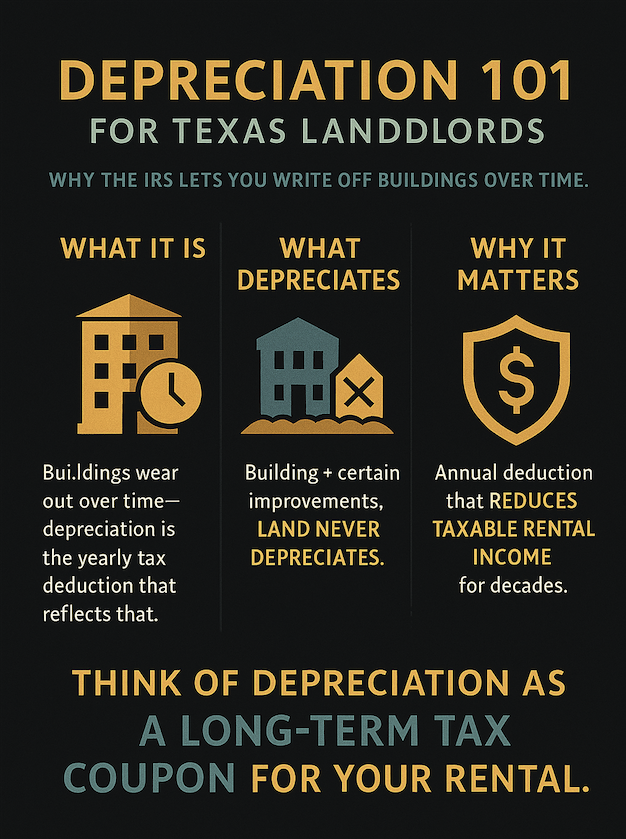
In plain terms, depreciation is the IRS’s way of acknowledging that buildings (unlike land) wear down over time. Roofs age, HVAC systems break, and flooring needs replacing. Instead of letting you deduct the entire cost of your rental property in the year you buy it, the IRS spreads that deduction out over the property’s “useful life.”
For landlords, that means you can write off a portion of your property’s value each year as an expense, lowering your taxable income.
Think of it as a long-term tax coupon: you don’t get all the savings upfront, but you get steady annual deductions for decades.
The IRS Timelines: Residential vs. Commercial
Here’s where a lot of landlords get tripped up—different properties have different timelines.
- Residential Rental Property:
If you own a single-family home, duplex, triplex, apartment building, or anything primarily used for housing, the IRS says you must depreciate it over 27.5 years. - Commercial Property:
If your rental falls into the commercial category—think office space, retail strip, or warehouse—it gets a longer schedule of 39 years.
Notice what’s missing? The land itself. Land doesn’t wear out (at least according to the IRS), so you can’t depreciate it. Only the building and certain improvements count.
Example:
You buy a rental property in Austin for $300,000. An appraisal shows the land is worth $60,000, and the building is worth $240,000. You’ll depreciate the $240,000 portion, not the land. That gives you about $8,727 in depreciation expense each year for 27.5 years.
How Depreciation Actually Works
Depreciation isn’t optional—it’s required once a property is “placed in service” (meaning ready to rent, even if it’s vacant at the time). The IRS uses a method called MACRS (Modified Accelerated Cost Recovery System) for real estate. Within MACRS, rental property is depreciated using the straight-line method.
That means you deduct the same amount every year until you’ve written off the full cost basis of the property (minus land).
Mid-Month Convention
Another wrinkle: the IRS assumes all real estate is placed in service or disposed of in the middle of the month. So even if you close on July 1st, depreciation starts mid-July.
Depreciating Improvements
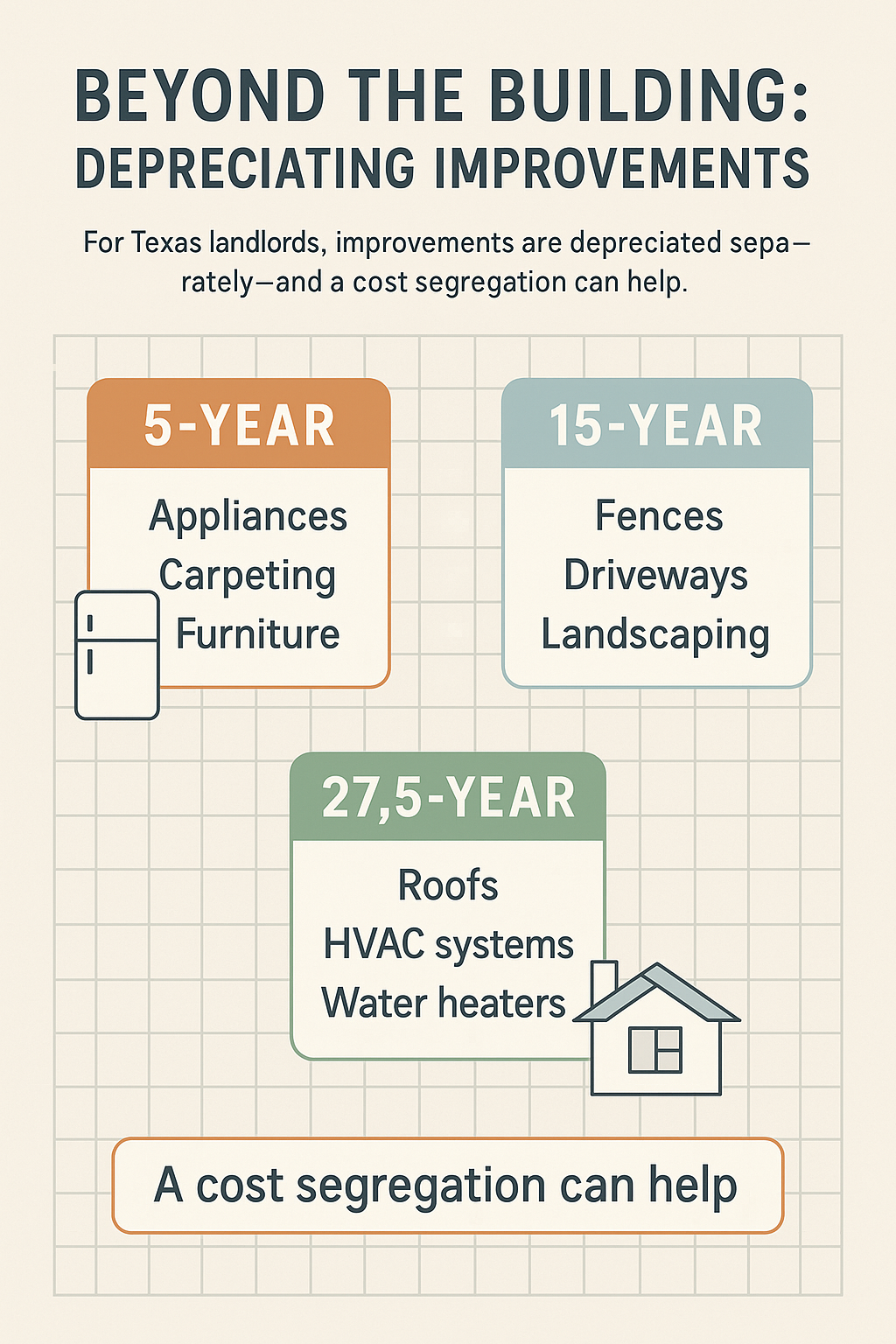
Depreciation doesn’t stop with the building itself. Many improvements and big-ticket items have their own depreciation schedules. For instance:
- Appliances, carpeting, and furniture: 5 years
- Fences, driveways, landscaping: 15 years
- Roofs, HVAC systems, water heaters: 27.5 years (since they’re considered part of the building)
This is where cost segregation studies come into play. A cost segregation professional can separate out certain items into shorter depreciation categories, letting you accelerate deductions. For landlords with multiple properties or larger buildings, this can mean thousands in upfront tax savings.
Common Mistakes Texas Landlords Make
Even seasoned property owners can slip up on depreciation. Here are some of the most common errors:
- Forgetting to Depreciate
Some landlords—especially DIY filers—don’t realize they must depreciate. The IRS requires it, and if you skip it, you can’t just go back later and claim all the missed deductions in one lump sum without filing a special adjustment (Form 3115). - Depreciating Land
Land isn’t depreciable. Accidentally including it inflates deductions and risks an audit. Always separate land and building value. - Using the Wrong Timeline
Mixing up residential (27.5 years) with commercial (39 years) happens more often than you’d think, especially if a property has mixed use. The key: if more than 80% of the square footage is residential, you use the residential timeline. - Not Adjusting for Improvements
Installing a new roof or HVAC? That cost should be depreciated separately, not lumped in with repairs. Repairs (like fixing a leak) are deductible immediately, but improvements (like replacing the whole roof) must be depreciated. - Forgetting About Recapture
Here’s the catch: when you sell the property, the IRS claws back some of those deductions through depreciation recapture. You’ll pay up to 25% tax on the depreciation you claimed (or could have claimed). Planning for this ahead of time can soften the blow.
Why Depreciation Matters for Texas Landlords
Texas doesn’t have a state income tax, which is a big win for property owners. But federal taxes still apply, and depreciation is one of the most powerful tools you have to minimize them.
Without depreciation, many landlords would find their rental income pushed into higher tax brackets. With it, you can reduce taxable income significantly, often making the difference between a profitable year and one where Uncle Sam eats too much of your return.
Bonus Depreciation and Section 179
While the building itself must be depreciated over 27.5 or 39 years, some property improvements qualify for bonus depreciation or Section 179 expensing.
- Bonus Depreciation: Allows you to write off a large percentage of qualifying assets in the first year. The Tax Cuts and Jobs Act set this at 100% through 2022, but it’s now phasing down (80% in 2023, 60% in 2024, 40% in 2025, and so on).
- Section 179: Lets you deduct the full purchase price of qualifying equipment and improvements in the year they’re placed in service. However, it’s typically more useful for active trades or businesses than rental property owners.
For landlords making upgrades like new appliances, bonus depreciation can be a big perk—though always check with a tax professional since rules change frequently.
Practical Example for Texas Landlords
Let’s say you buy a duplex in Houston for $400,000. The land is worth $100,000, leaving $300,000 for the building.
- Annual depreciation on the building: $300,000 ÷ 27.5 = $10,909
- Add appliances for $6,000 (5-year depreciation) = $1,200/year
- Add a new driveway for $15,000 (15-year depreciation) = $1,000/year
That’s over $13,000 in annual depreciation deductions—before even counting repairs, mortgage interest, insurance, or other expenses.
Depreciation for Short-Term Rentals
Here’s a gray area: what about Airbnbs or VRBO properties? If you’re operating a property primarily as a short-term rental, the IRS may consider it more of an active trade or business than a passive rental activity. That opens the door for Section 179 deductions and different treatment of expenses.
But classification depends on details like:
- Average guest stay (30 days or fewer = short-term rental)
- Whether you provide services (cleaning, meals, tours)
- How actively you’re involved in management
Many Texas landlords who pivoted to short-term rentals during the pandemic discovered their depreciation options changed, for better or worse. It’s a prime example of why professional guidance matters.
Planning for the Future: Exit Strategies and Depreciation Recapture
Depreciation isn’t free money—it’s a deferral. When you sell, the IRS wants its share through recapture tax. But smart landlords plan around it:
- 1031 Exchanges: Roll proceeds into another property to defer both capital gains and recapture tax. For example, a San Antonio landlord who sells a $500,000 rental can reinvest in another property of equal or greater value and continue growing their portfolio without immediate tax pain.
- Step-Up in Basis: If heirs inherit the property, its basis resets to fair market value, effectively wiping out prior depreciation. That’s why many landlords use real estate as a long-term wealth transfer strategy.
- Strategic Sales: Selling in lower-income years—say, after retirement—can reduce your recapture tax rate and overall liability.
Record-keeping: The Unsung Hero of Depreciation
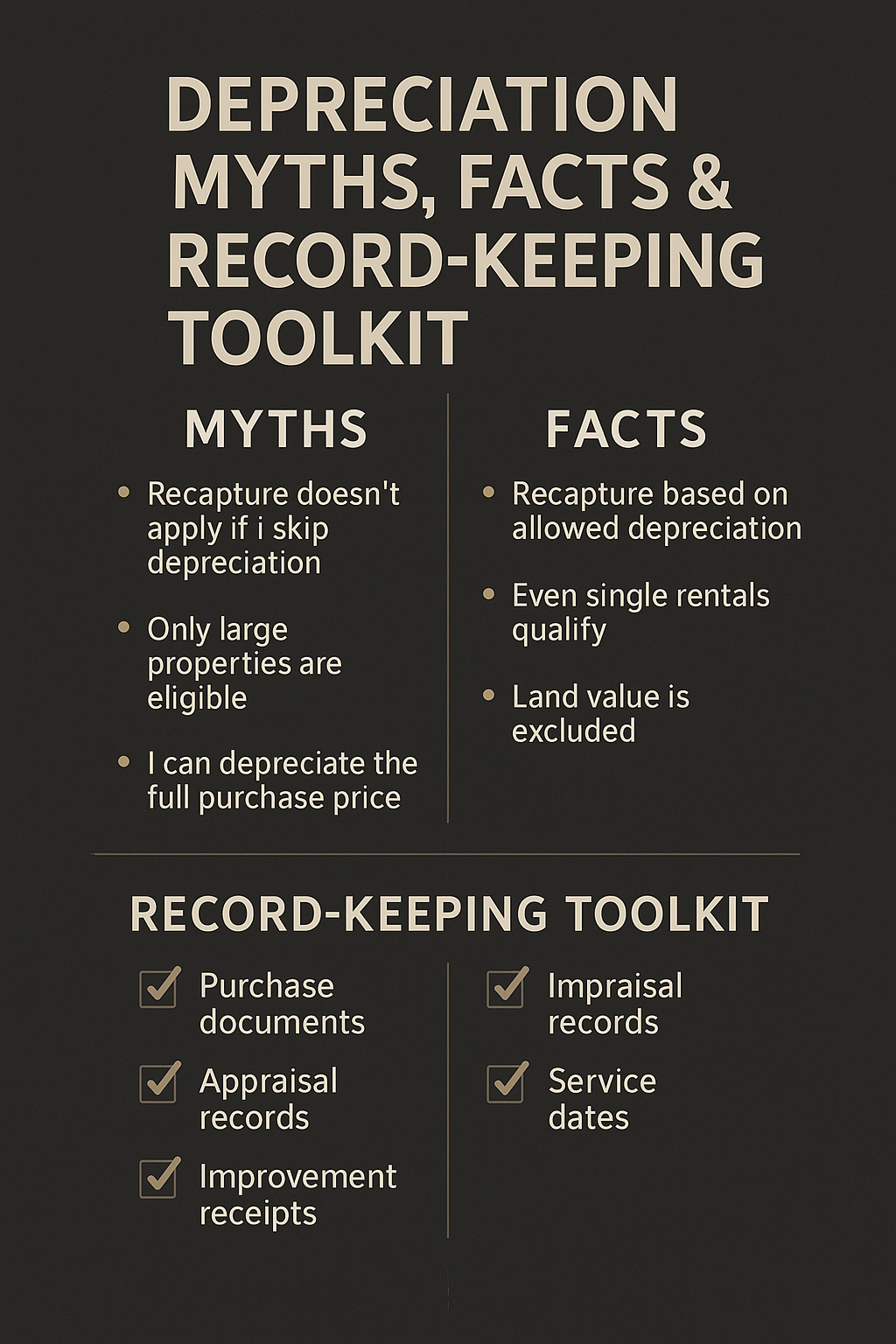
One of the biggest challenges with depreciation isn’t the math—it’s the paperwork. If the IRS audits you, they’ll want proof of:
- Purchase price and closing statements
- Appraisals or county tax records separating land and building value
- Receipts for improvements
- Dates properties were placed in service
Good record-keeping can make the difference between a smooth audit and a nightmare. Many Texas landlords now lean on property management software or accounting platforms that track this automatically.
Myths vs. Facts About Depreciation
- Myth: “If I don’t claim depreciation, I don’t have to pay recapture.”
Fact: The IRS calculates recapture based on what you should have claimed, not what you actually claimed. - Myth: “Depreciation only matters for big apartment complexes.”
Fact: Even a single rental home qualifies, and the annual savings add up fast. - Myth: “I can depreciate the full purchase price.”
Fact: Land must always be carved out—only the building and improvements qualify.
Working with Professionals
Depreciation rules are complex, and mistakes can be costly. Many Texas landlords partner with property managers who track expenses and improvements, or with CPAs who specialize in real estate. The cost of professional advice often pays for itself many times over.
Final Word
Depreciation may sound like a dry tax concept, but for Texas landlords, it’s one of the most important financial tools available. Used wisely, it can slash your tax bill, boost your returns, and help you build long-term wealth through real estate.
The key is understanding the rules: residential vs. commercial timelines, separating land and improvements, tracking upgrades, and preparing for recapture. Combine that knowledge with good record-keeping and professional guidance, and depreciation shifts from intimidating jargon to a landlord’s best friend.


