

This Content Is Only For Subscribers
The holidays magnify everything—joy, stress, and yes, complaints. More guests, tighter parking, louder nights, and shorter tempers make December a hotspot. Your job isn’t to promise perfection; it’s to respond quickly, apply the lease consistently, and keep the building calm. Here’s a streamlined, people-first playbook.
Why complaints spike
- Crowds & guests: Extra cars, full trash rooms, longer shower lines.
- Schedule stress: Travel, school breaks, tight budgets.
- Weather: Storms, ice, and cold snaps amplify small issues.
- Expectations: People want “perfect holidays” at home.
Your edge: tone, timing, and fair process.
A simple response framework
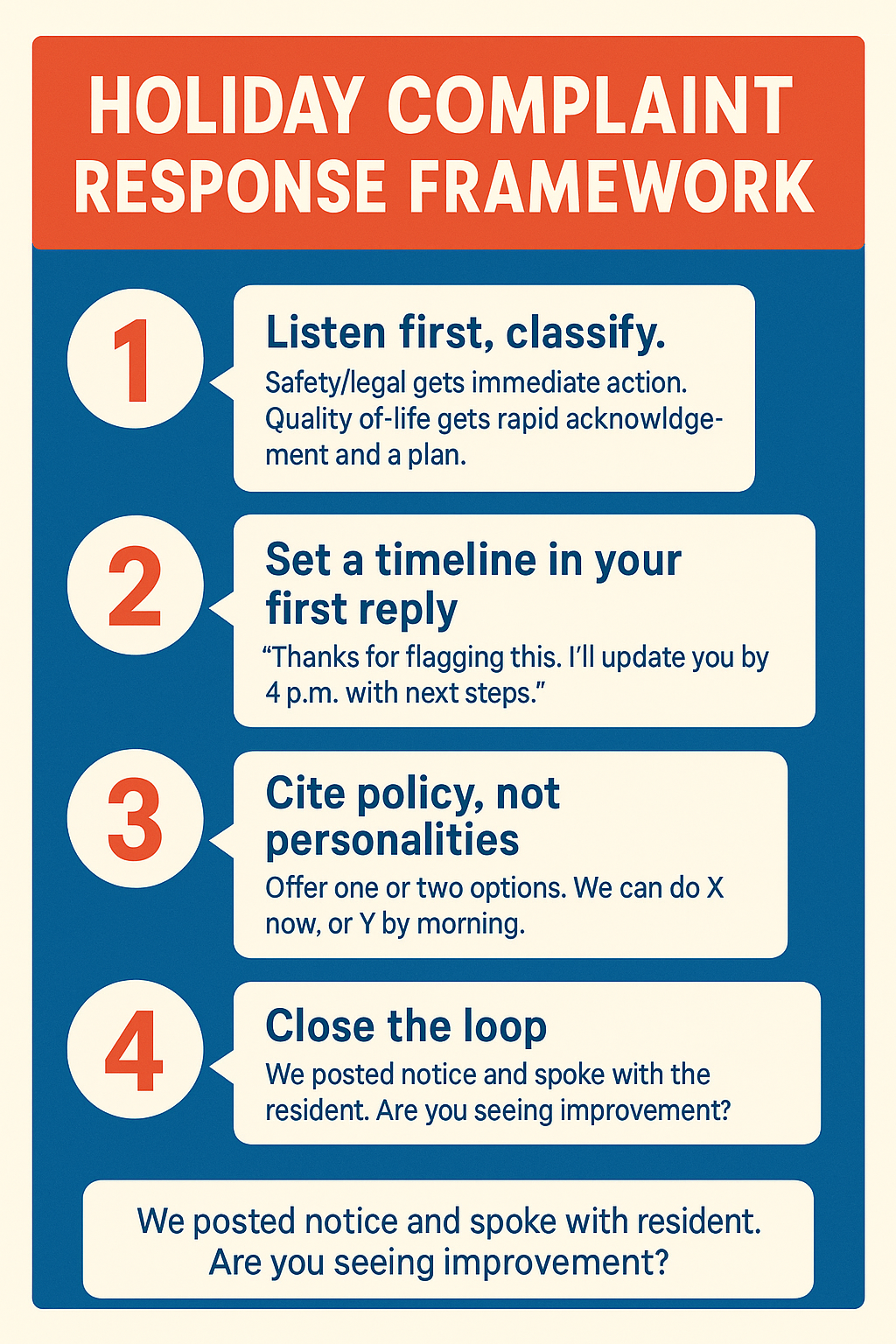
1) Listen first, classify. Safety/legal (gas smell, threats, fire hazards) gets immediate action. Quality-of-life (noise, odors, parking) gets rapid acknowledgement and a plan.
2) Set a timeline in your first reply.
“Thanks for flagging this. I’ll update you by 4 p.m. with next steps.”
3) Cite policy, not personalities. Quiet hours, guest parking, smoking, pets—consistency keeps it neutral.
4) Offer one or two options. Agency calms people: “We can do X now, or Y by morning.”
5) Close the loop.
“We posted notice and spoke with the resident. Are you seeing improvement?”
Tone that helps: Validate (“I hear how frustrating that is”), be specific (“music after 10 p.m.”), avoid vague promises (“We’ll recheck at 10:30 per quiet hours”).
Common December complaints—fast playbook
Noise & parties
First step: Confirm time/type; check quiet hours.
Action: Friendly reminder for first incident; written warning for repeats; escalate to security or non-emergency line if it continues.
To host:
“Hope you’re enjoying the season. Quick reminder—quiet hours start at 10 p.m. Please bring music inside and lower bass.”
To reporter:
“I reminded them and will recheck in 30 minutes. If it continues after 10 p.m., text me and we’ll escalate per policy.”
Parking chaos
Distinguish: Blocked access vs. scarcity.
Action: Contact vehicle; tow per posted rules if blocking persists. For overflow, assign Lot B and post temporary signage.
Script:
“We’ve contacted the owner. If it isn’t moved in 15 minutes, we’ll tow per policy.”
Smoking/odor (including cannabis)
Check: Smoke-free status and ventilation.
Action: Document, notify, offer mitigation (door sweeps), enforce on repeats.
Script:
“We received an odor report. Our community is [smoke-free/restricted]. Please use the designated area.”
Package pileups & theft
Verify: Delivery photo/time, camera coverage.
Action: Guide carrier claim; enable lockers, office holds, or delivery notes.
Script:
“I’m sorry that happened. Start a carrier claim with the delivery photo. I can set you up with lockers or office holds.”
Decorations & fire safety
Separate: Taste vs. hazard (open flames, blocked egress, overloaded cords).
Action: Courtesy reminder; require removal if unsafe.
Script:
“The wreath is fine, but the cord across the hall blocks egress. Please remove today.”
Temperature disputes
Check: Actual indoor temp, thermostat setting, filter.
Action: If within habitability, share efficiency tips and offer a compliant space heater with safety sheet.
Script:
“Your unit is 69°F, which meets standard. I can drop off a heater and schedule a filter swap.”
Pets & guests
Check: Lease limits on visiting pets and occupancy duration.
Action: Friendly reminder; formal notice for repeats.
Script:
“Overnight stays beyond 14 days need written approval. Share dates so we can document.”
Legal, fair, consistent
- Apply the same rule the same way to similar cases.
- Document facts: time, location, photo of blocked space, copy of notice.
- Avoid discrimination/retaliation pitfalls—stick to behavior and lease terms.
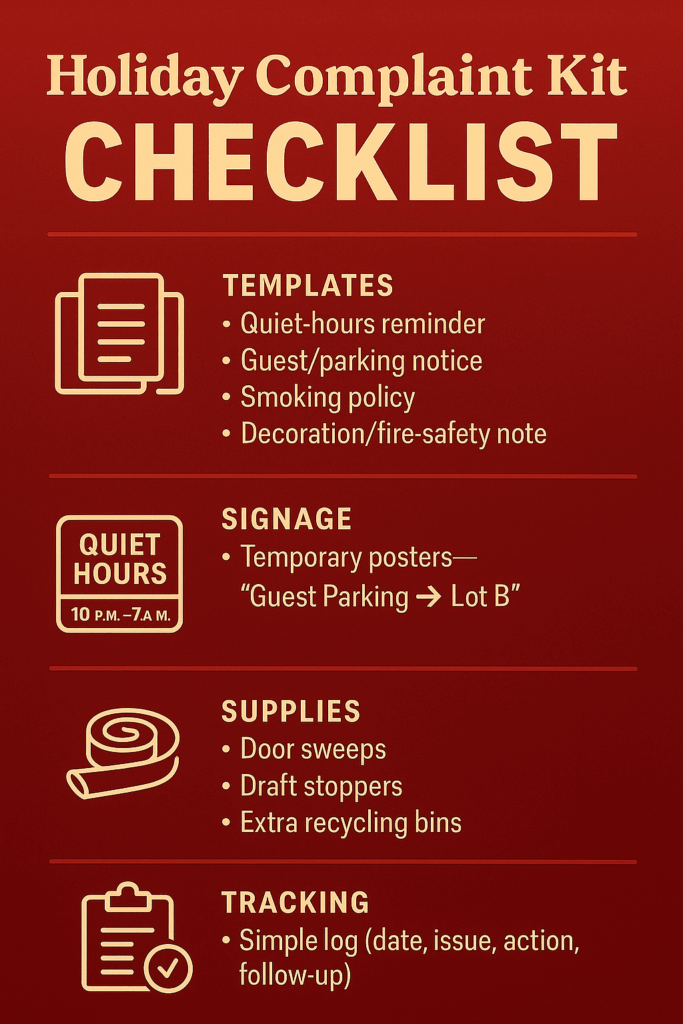
Your holiday complaint kit
- Templates: Quiet-hours reminder, guest/parking notice, smoking policy, decoration/fire-safety note.
- Signage: Temporary posters—“Quiet Hours 10 p.m.–7 a.m.” “Guest Parking ➜ Lot B.”
- Supplies: Door sweeps, draft stoppers, extra recycling bins.
- Tracking: Simple log (date, issue, action, follow-up) to show diligence and spot patterns.
The graceful finish
Grace isn’t letting things slide—it’s firm rules delivered with a warm voice and quick follow-through. Listen first, anchor in policy, give a clear next step, and close the loop. Do that consistently and you’ll defuse most conflicts before they ignite, keep the community feeling cared for, and head into January with fewer grudges and better reviews.


