

This Content Is Only For Subscribers
An expense is money you spend. An investment is capital you deploy to generate a return. The fundamental distinction between a casual landlord and a serious real estate investor lies in the understanding of that single sentence. A landlord sets rent based on what they think is “fair” or what they charged last year; an investor sets rent based on real-time market data, supply and demand velocity, and a calculated strategy to maximize Net Operating Income (NOI).
Welcome back to Investor Corner, the column dedicated to the business of real estate. We are not here to talk about the color of the year or the latest design fads. We are here to talk about numbers. We are here to analyze how to deploy capital and optimize operations to maximize cash flow, increase NOI, and drive long-term appreciation. And with the peak Texas leasing season upon us, the single most important question an investor can ask is: how do I price my assets right now to capture the greatest possible return?
The Psychology of the Summer Market
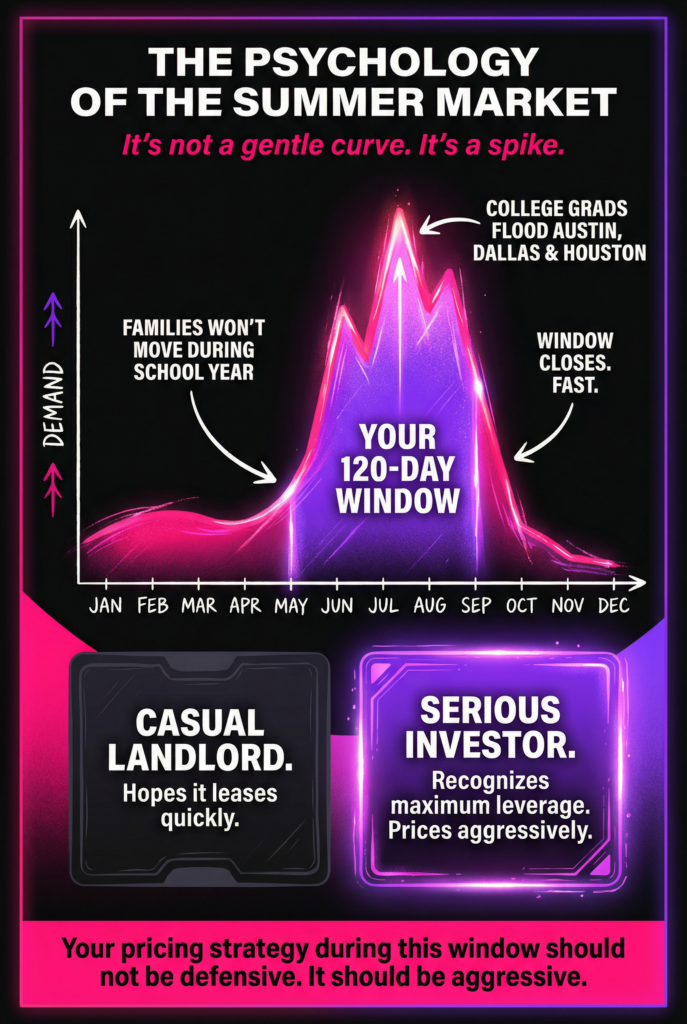
Before we talk about specific pricing strategies, we must address the psychology of the high-demand summer market. In Texas, the leasing season is not a gentle curve; it is a sharp, aggressive spike that begins in May and crashes in September.
This spike is driven by immovable external factors. Families refuse to move during the school year. Corporate relocations are overwhelmingly scheduled for the summer months. College graduates flood the major metros of Austin, Dallas, and Houston in June.
For an investor, this means the demand side of the equation is artificially inflated for a 120-day window. Tenants during this period are highly motivated, often desperate, and operating under strict deadlines. They are less price-sensitive and more speed-sensitive. A casual landlord looks at this surge and simply hopes their property leases quickly. A serious investor looks at this surge and recognizes it as a brief window of maximum leverage. Your pricing strategy during this window should not be defensive; it should be aggressive.
The Danger of the “Set It and Forget It” Model
The most common mistake landlords make is treating rent as a static number. They look at a property, decide it is a “$2,000-a-month house,” and leave that number unchanged until the tenant moves out.
This “set it and forget it” model is a guaranteed way to leave money on the table. Real estate is a dynamic commodity. Its value fluctuates based on macro-economic trends, hyper-local neighborhood developments, and, crucially, seasonal demand.
If you price a unit at $2,000 in November, that might be the absolute ceiling of what the market will bear. If you price that exact same unit at $2,000 in July, you are likely underpricing it by 5% to 10%. In the investment world, an underpriced asset is not a “good deal” for the tenant; it is a failure of management by the owner. Every dollar of rent you fail to capture is a dollar subtracted directly from your NOI, which exponentially decreases the overall valuation of your property.
Implementing Dynamic Pricing Principles
The airline and hospitality industries have used dynamic pricing for decades. A hotel room in Galveston costs significantly more on the Fourth of July weekend than it does on a Tuesday in February. The product is identical, but the demand is different, so the price adjusts accordingly.
Real estate investors must adopt this same methodology. Dynamic pricing is the practice of adjusting your rent based on real-time market conditions. During the summer peak, your pricing strategy should be fluid, not fixed.
Testing the Ceiling
When a property comes vacant in June, your initial listing price should not be your target rent; it should be an aggressive test of the market ceiling.
If your target rent based on comparable properties is $2,200, list the property at $2,350. You are not trying to gouge the market; you are trying to discover where the top of the market actually is. In a high-demand environment, you may find a highly motivated tenant willing to pay that premium to secure a property before the school year begins. If you secure a lease at $2,350, you have just permanently increased your NOI.
The 48-Hour Adjustment Rule
The key to testing the ceiling is velocity. You cannot list a property at an aggressive price and let it sit for three weeks. Vacancy is the enemy of cash flow.
When you list at a premium price, you must monitor the market response obsessively. In the summer, the market speaks quickly. If you list a property on a Thursday and have zero showings and zero applications by Monday morning, the market has rejected your price.
You must implement a strict 48-to-72-hour adjustment rule. If the property is not generating significant interest at $2,350 within three days, drop the price to $2,275. If another three days pass without an application, drop it to your target of $2,200. This rapid, stair-step approach allows you to test the absolute maximum price without suffering extended vacancy.
The Risk of Overpricing
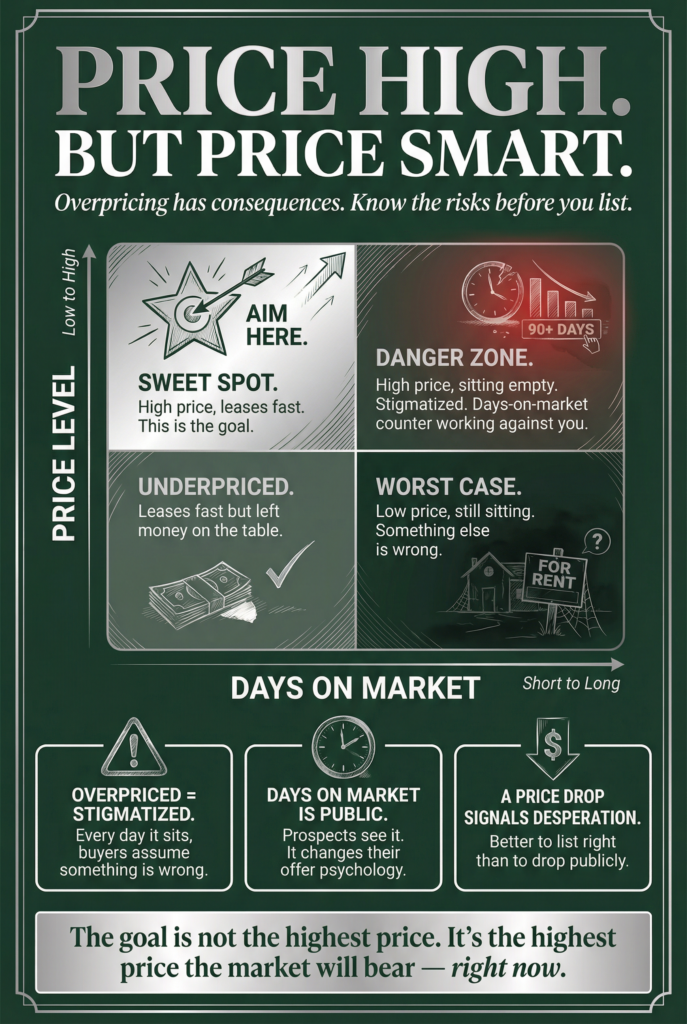
While the core message of this strategy is to be aggressive during peak months, it is crucial to understand the difference between aggressive pricing and reckless overpricing.
Aggressive pricing is testing the top of the market with a defined, data-driven plan and a willingness to adjust quickly if the market rejects your number. Reckless overpricing is demanding an exorbitant rent simply because it is July, ignoring comparable properties, and refusing to lower the price when the property sits vacant for a month.
When you overprice a property and let it sit vacant, you trigger a cascade of negative financial consequences. First, you lose the immediate cash flow. If a property sits vacant for one month to capture an extra $50 in rent, it will take you 40 months just to break even on the lost month of income. Second, properties that sit vacant for extended periods during the peak season often become stigmatized. Prospective tenants will see the “Days on Market” metric on listing sites and assume there is something fundamentally wrong with the house.
Strategic Lease Expirations
Pricing strategy is not just about what you charge today; it is about positioning your asset for maximum return in the future. The most critical, and often overlooked, element of summer pricing is controlling the lease expiration date.
If you sign a 12-month lease in November, that lease will expire the following November. You have just guaranteed that your next turnover will occur during the lowest-demand period of the year, forcing you to accept lower rent and likely suffer a longer vacancy.
As an investor, you must aggressively manipulate lease terms to ensure they expire during the summer peak. If you are signing a new tenant in November, do not offer a 12-month lease. Offer a 6-month lease or an 18-month lease so the expiration lands in May or June.
When you are signing leases during the summer rush, you have the leverage to dictate the terms. Offer standard 12-month leases to keep the cycle in the summer, or offer 13- or 14-month leases to stagger your turnovers so you do not have your entire portfolio going vacant in the exact same week next year.
The Role of Renewal Pricing
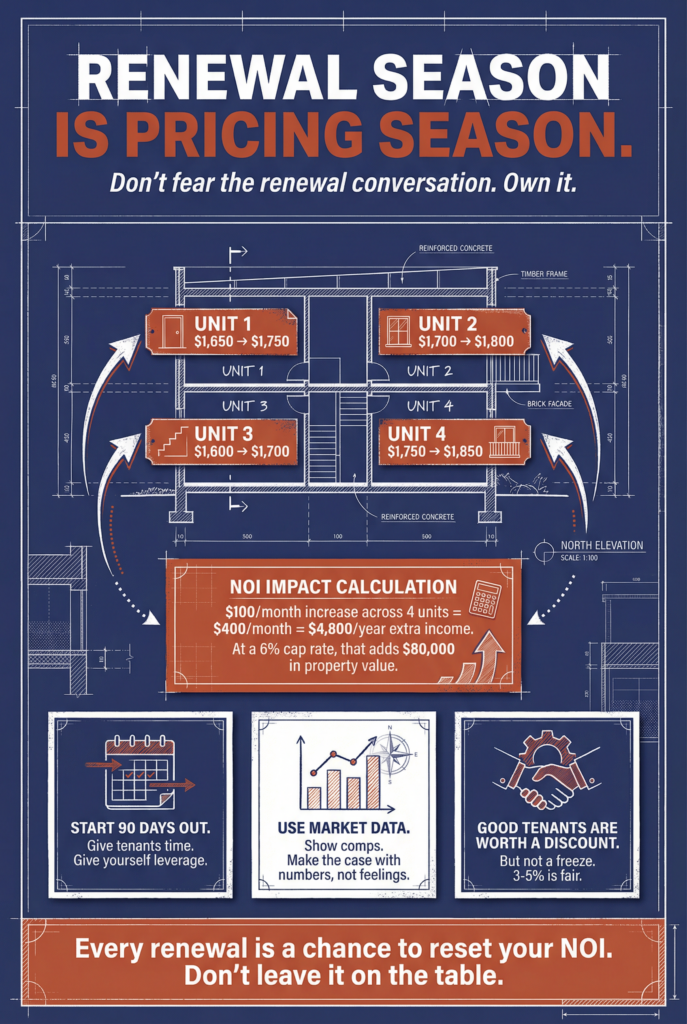
The final component of a comprehensive summer pricing strategy is managing your existing tenant base. When a lease comes up for renewal during the peak season, you must evaluate that renewal through an investor’s lens.
Many landlords are terrified of turnover, so they offer flat renewals or nominal $25 increases, even when the market has appreciated significantly. This is an emotional decision, not a financial one.
When a lease expires in July, you hold the cards. The cost and hassle for a tenant to move during the summer heat is immense. You must run a new market analysis for every single renewal. If the market rent for the property is now $2,500, and the tenant is currently paying $2,200, a $25 increase is unacceptable.
You must present the tenant with a renewal offer that reflects the current market reality. Offer the renewal at $2,450—a slight discount to the open market to incentivize them to stay, but a massive increase to your NOI. If they choose to leave, you simply take the property to the open market at the peak of the season and capture the full $2,500. Either way, the asset performs at its maximum potential.
The Financial Impact of Strategic Pricing
To truly understand the power of strategic pricing, we must quantify the impact on the overall value of the asset. The value of commercial and multifamily real estate is directly tied to its Net Operating Income (NOI) through the capitalization rate (cap rate) formula. While single-family homes are primarily valued on comparable sales, their performance as an investment is still fundamentally driven by cash flow.
Consider a hypothetical fourplex in a strong Texas market. The owner, operating with a “set it and forget it” mindset, renews all four leases in June at $1,500 per month, fearing vacancy. The total annual gross income is $72,000.
Now consider an investor who implements a dynamic pricing strategy. Recognizing the summer demand spike, the investor pushes the renewals to market rate, securing two renewals at $1,650 and turning over the other two units to new tenants at $1,700. The new total annual gross income is $80,400.
The investor has increased the gross income by $8,400 per year. Assuming operating expenses remain constant, that entire $8,400 drops straight to the bottom line as increased NOI.
If this fourplex were valued at a 6% cap rate, that $8,400 increase in NOI translates to a $140,000 increase in the total value of the property ($8,400 / 0.06). By simply pricing the asset correctly during the high-demand summer months, the investor created $140,000 in forced appreciation without swinging a single hammer or spending a dime on renovations.
Conclusion: The Math Over Emotion
Strategic pricing requires discipline. It requires you to ignore the emotional discomfort of asking for more money and focus entirely on the math. The Texas summer market provides a brief, intense window of opportunity. As an investor, your mandate is to capitalize on that window.
By abandoning the passive approach, aggressively testing the market ceiling, manipulating lease expirations, and treating renewals as market-rate negotiations, you transform pricing from a guess into an active tool for wealth creation. The demand is there. The question is whether you have the strategy in place to capture it.


