

This Content Is Only For Subscribers
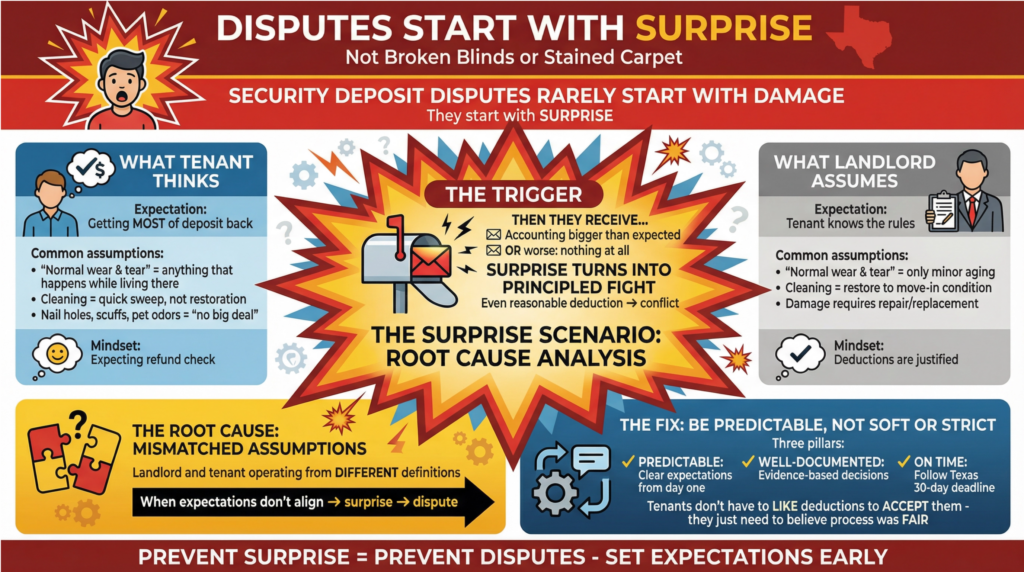
Security deposit disputes rarely start with a broken blind or a stained carpet. They start with surprise. A tenant thinks they’re getting most of their deposit back, and then they receive an accounting that feels bigger than expected—or worse, nothing at all. From there, even a reasonable deduction can turn into a principled fight.
For small landlords renting houses in Texas, avoiding disputes isn’t about being “soft” or “strict.” It’s about being predictable, well-documented, and on time. Here’s how to reduce the odds of a deposit disagreement and how to handle one if it still happens.
1) Set expectations before move-in (not at move-out)
Most disputes are rooted in mismatched assumptions. Tenants often believe:
- “Normal wear and tear” includes anything that happens while they live there.
- Cleaning means a quick sweep, not restoring the home to move-in condition.
- Nail holes, scuffs, and pet odors are “no big deal.”
Landlords often assume the opposite.
Fix this early by spelling out the basics in writing—ideally in the lease and again in a simple move-in email. Keep it practical:
- What “clean” means (kitchen appliances, bathrooms, floors, trash removal)
- Yard expectations (mowing frequency, watering rules, leaf removal)
- What requires permission (painting, TV mounts, pets)
- How to report issues to avoid damage getting worse (small leak becomes big drywall repair)
Tenants don’t need a lecture. They need clarity.
2) Make the deposit process feel professional, not personal
Tenants get nervous when deposits feel like a “judgment.” Your job is to make it feel like an accounting.
A few habits help:
- Use neutral language: “replace,” “repair,” “cleaning beyond normal,” instead of “destroyed” or “trashed.”
- Tie charges to evidence and invoices.
- Avoid lump-sum deductions whenever possible.
Even when you’re right, tone can determine whether a tenant accepts the outcome or goes looking for a fight.
3) Know the most common flashpoints—and prevent them
Cleaning charges
Cleaning is one of the biggest dispute magnets because it’s subjective.
To prevent arguments:
- Put cleaning expectations in the lease (or a move-out checklist addendum).
- Give the tenant a move-out checklist 2–3 weeks before they leave.
- Photograph the “before” at move-in and the “after” at move-out in the same spots.
If you charge cleaning, be ready to show it wasn’t just routine turnover—it was necessary because of the tenant’s condition.
Paint and walls
Tenants often don’t understand the difference between refresh and repair.
Prevention strategy:
- Document wall condition at move-in (photos of scuffs, chips, or existing nail holes).
- Put clear rules on painting and mounting hardware.
- At move-out, charge for specific repairs (patch/texture match) rather than “full repaint” unless the tenant’s actions truly required it.
Pets and odor
Pet disputes are rarely about the pet—it’s about odor and staining that show up after furniture is gone.
Prevention strategy:
- Require written pet permission.
- Do periodic inspections if allowed under your lease (with proper notice).
- If odor exists, document it and use professionals when needed (enzyme treatment, sealing, etc.).
Yard and exterior
Houses add outdoor responsibilities that apartment tenants may be new to.
Prevention strategy:
- Spell out who does what: mowing, watering, weeds, shrubs, sprinkler damage.
- Photograph the yard at move-in (including bare spots and stressed areas).
- If the tenant is responsible, consider providing a simple schedule (or require a service and proof).
4) Do a pre-move-out walkthrough (when possible)
If you can, offer a walkthrough 10–14 days before move-out. This is one of the best dispute-prevention tools because it replaces surprise with choices.
A pre-walkthrough lets you say:
- “These blinds are broken—if you replace them before move-out, you’ll save money.”
- “There’s heavy buildup in the oven—here’s what needs to be cleaned.”
- “The yard needs mowing and edging.”
You’re not negotiating. You’re giving the tenant a chance to fix issues at a lower cost than your post-move-out vendors.
Even if the tenant declines, the offer itself can help you later: it shows you tried to be reasonable.
5) Document like you expect a challenge
In a dispute, the landlord who wins is usually the one with the best file, not the loudest argument.
At minimum, keep:
- Move-in condition form (signed)
- Move-in photos/video
- Move-out photos/video
- Invoices/receipts (or clear, reasonable cost documentation)
- A copy of the deposit accounting and proof it was sent
A “before and after” photo pair is incredibly persuasive. It turns “I didn’t do that” into “Here’s what it looked like when you moved in.”
6) Follow Texas timelines and mailing practices carefully
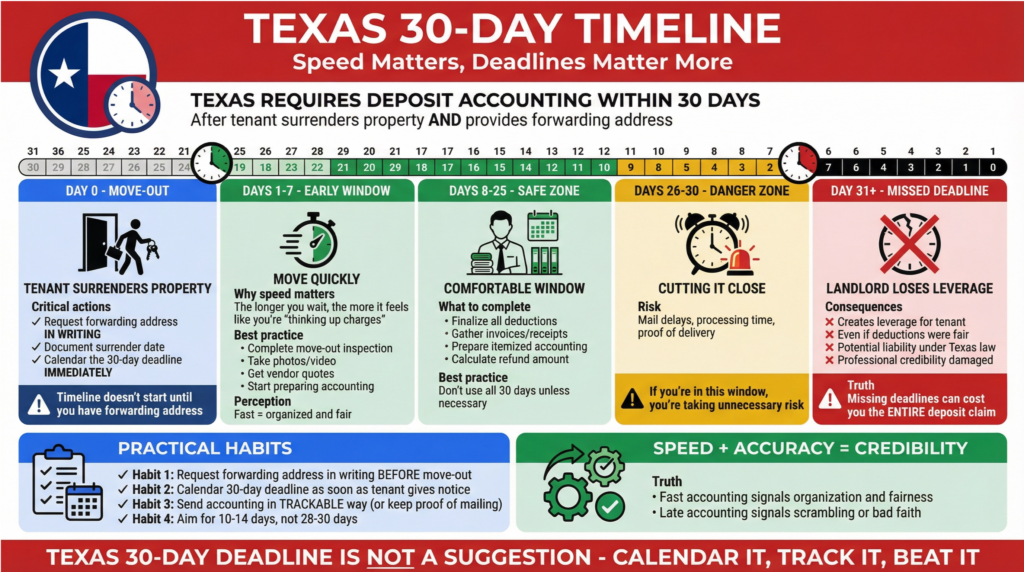
Texas generally requires you to return the deposit and/or provide an itemized accounting within 30 days after the tenant surrenders the property and provides a forwarding address. Missing deadlines creates leverage for the tenant, even if your deductions were fair.
Practical habits:
- Request the forwarding address in writing before move-out.
- Calendar the 30-day deadline as soon as you learn the tenant is leaving.
- Send the accounting in a trackable way when possible (or keep proof of mailing).
Speed matters too. The longer you wait, the more it feels like you’re “thinking up charges.”
7) If a tenant disputes deductions, respond like a business
Even with great documentation, disputes happen. When they do, your response should be calm, short, and evidence-based.
A strong approach:
- Acknowledge the message.
- Restate the key facts (move-in condition, move-out condition, lease basis for deductions).
- Offer to share supporting photos/invoices (or attach them).
- Avoid arguing about feelings, motives, or character.
Example tone (not a script, just a model):
- “Thanks for reaching out. The deductions were based on documented move-out condition compared to move-in photos and the lease requirements. I’ve attached the invoices and the relevant photos for your review.”
If you made a mistake—own it quickly. A small correction now can prevent a bigger conflict later.
8) Know when to compromise—and how to do it safely
Sometimes the cost of being “right” is higher than the cost of settling. If a tenant disputes a borderline item (like minor paint touch-ups), it can be smart to compromise.
If you do, keep it professional:
- Put the agreement in writing.
- State it’s a one-time settlement of deposit claims.
- Document the refund amount and date.
Compromise isn’t weakness. It’s risk management.
The bottom line
Security deposit disputes are preventable when your process is predictable:
- Clear expectations in the lease and move-out checklist
- Strong move-in and move-out documentation
- Objective, invoice-backed deductions
- On-time, professional accounting
Tenants don’t have to like deductions to accept them. They just need to believe the process was fair—and that you can prove it.


