This Content Is Only For Subscribers
If you felt like 2025 was one long alphabet soup of “SB-this” and “HB-that,” you’re not wrong. The 89th Texas Legislature was busy, and 2026 is when a lot of that paper finally turns into real-world rules for how you lease, manage, and evict.
The good news: most of what’s coming isn’t out to “get” landlords. But it will change how you write your leases, handle problem occupants, and manage risk. If you walk into 2026 with 2019 habits, you’re going to step on some landmines.
Let’s break the big changes into plain English and talk about what a Texas landlord actually needs to do about them.
1. The Big One for 2026: SB 38 and the New Eviction Landscape
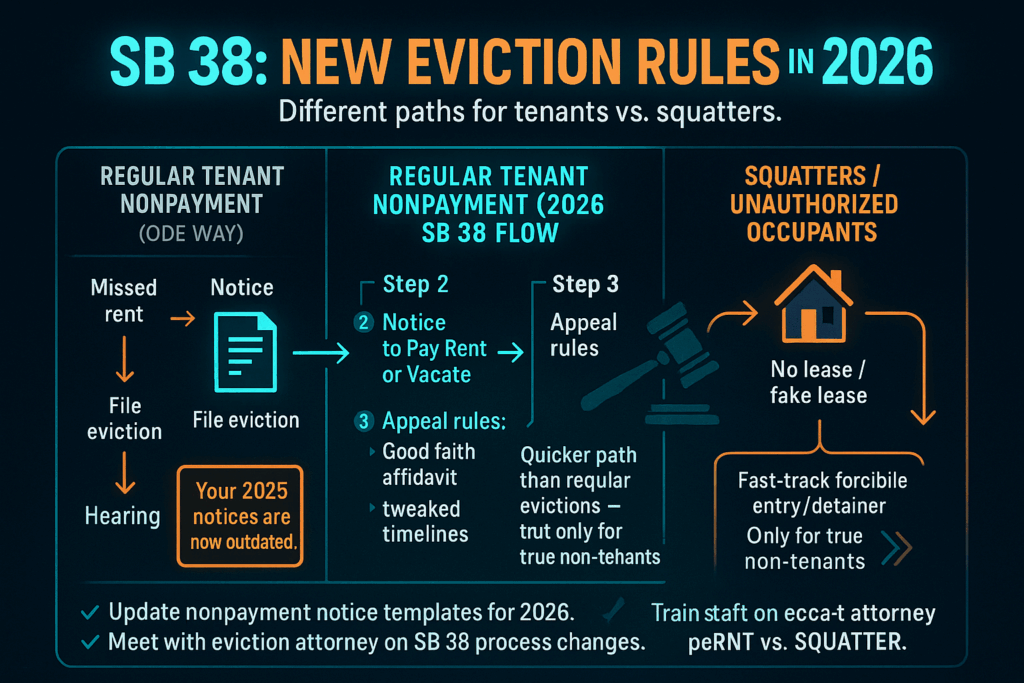
Senate Bill 38 is the headliner for 2026. It rewires parts of the eviction process and creates a faster path to remove people who were never tenants in the first place (“squatters”/unauthorized occupants). Most of it kicks in January 1, 2026.
Advocates stripped out some of the harshest early proposals, but what passed still matters a lot for owners:
What changes for tenants in regular eviction cases
According to Texas Housers’ fact sheet on the final bill, SB 38 now:
- Introduces a “notice to pay rent or vacate” when a tenant has missed only one rent payment. For the first time in Texas statute, that’s a limited “right to cure” by paying up before you move straight to filing.
- Tweaks procedures around appeals, timelines, and hearings, including new requirements for tenants who appeal to swear their appeal is in “good faith,” and rules limiting some remote/electronic hearings.
Practically, that means:
- Your nonpayment notices and form letters for 2026 need to be brought up to date. The wording, timing, and documentation you use may no longer match the statute.
- If you file a lot of evictions, you and your attorney or property manager should walk through exactly how your process will change under SB 38 before January rolls around.
What changes for squatters and trespassers
The “speed it up” parts of SB 38 mostly landed on the forcible entry and detainer side — cases about unauthorized occupants rather than your normal lease-based eviction. Summary “quick” dispositions that were originally pitched for renters got narrowed down to people who were never legally there to begin with.
For you, this means:
- You’ll likely have a faster, more streamlined court path to remove someone who broke in or used a fake lease to get in.
- You’ll also have to be very clear, in your own records and filings, about whether you’re dealing with a tenant or a non-tenant — the rules differ.
Action items for landlords:
- Have your eviction attorney or association explain SB 38 in the context of your standard notices and filings.
- Update templates for nonpayment notices in early 2026.
- Train staff to spot the difference between a holdover/tenant dispute and a true “squatter” case so you don’t accidentally use the wrong procedure.
2. Squatters, Fake Leases, and SB 1333
You’re going to hear the word “squatter” a lot in 2026, and not just on social media.
SB 1333, effective September 1, 2025, gives owners a more direct way to work with law enforcement to remove unauthorized occupants and cracks down on fake leases and deed scams.
Key points:
- Landlords can file a sworn complaint and, in qualifying situations, have the sheriff or constable remove people who have no legal right to occupy the property — instead of trudging through a full-blown eviction lawsuit.
- It creates criminal offenses for:
- Presenting a fake lease to claim rights to a property
- Leasing out property you don’t own or have authority to rent
This sits on top of other anti-fraud bills (SB 647, SB 1734, SB 693, etc.) that beef up county clerks’ power to refuse fraudulent real estate filings and give property owners better tools to challenge bogus documents.
What to do in 2026:
- Keep clean proof of ownership handy (deed copies, ID, entity documents) so you can act quickly if someone occupies your place without permission.
- If you suspect a squatter situation or fake lease, do not DIY; talk to a lawyer or law enforcement about whether SB 1333 applies.
- Be extra cautious if you’re approached about weird “rent-to-own” or wholesaling deals that involve recording memorandums or affidavits against your title.
3. SB 17: Foreign Ownership & Lease Limits You Can’t Ignore
SB 17 got a lot of press as the “foreign ownership” bill. It has two angles that matter to landlords: who can own property, and how long certain people can lease for.
Highlights:
- The law restricts new real property acquisitions in Texas by certain foreign governments, entities, and individuals tied to countries flagged in federal national security reviews (including China, Russia, Iran, and North Korea).
- The Apartment Association of Greater Dallas notes that for leasing, SB 17 limits leases for unlawfully present persons from those countries to terms of less than one year (364 days or less).
This is where things get messy: you have to square SB 17 with fair housing and anti-discrimination law. Screening based on national origin or immigration status is a legal minefield.
Practical approach:
- Do not wing this one. If your applicant pool realistically includes affected categories, get a Texas real estate or fair-housing attorney to help you design compliant policies.
- If you use TAA forms, check for the SB 17 language they’ve added to their rental application and be sure your team understands what it does (and doesn’t) ask.
4. Floodplain & Flood History Disclosures: SB 2349
Want to be surprised by a flood and a lawsuit? No? Then pay attention to SB 2349, which tightened flood disclosure rules for rentals.
As of September 1, 2025, Texas landlords must:
- Provide a written notice if the property is in a FEMA-defined 100-year floodplain and
- Disclose if the property has flooded within the last five years, typically via a separate written document tied to Property Code § 92.0135.
The law does relax disclosures for certain short-term leases (under 30 days) and some lease-back arrangements, but for most ordinary Texas rentals, this is now mandatory paperwork.
Your 2026 checklist:
- Find out exactly whether each unit is in a 100-year floodplain and keep that documentation on file.
- Create or adopt a standard flood disclosure form and make it part of your normal lease packet.
- Have a system to track flood events so you’re not guessing when the five-year question comes up.
5. Repairs, Remedies, Security Deposits & Email (HB 2037)
HB 2037 made a couple of quiet-but-important tweaks to how you handle repairs and security deposits.
Two big takeaways noted by AAGD:
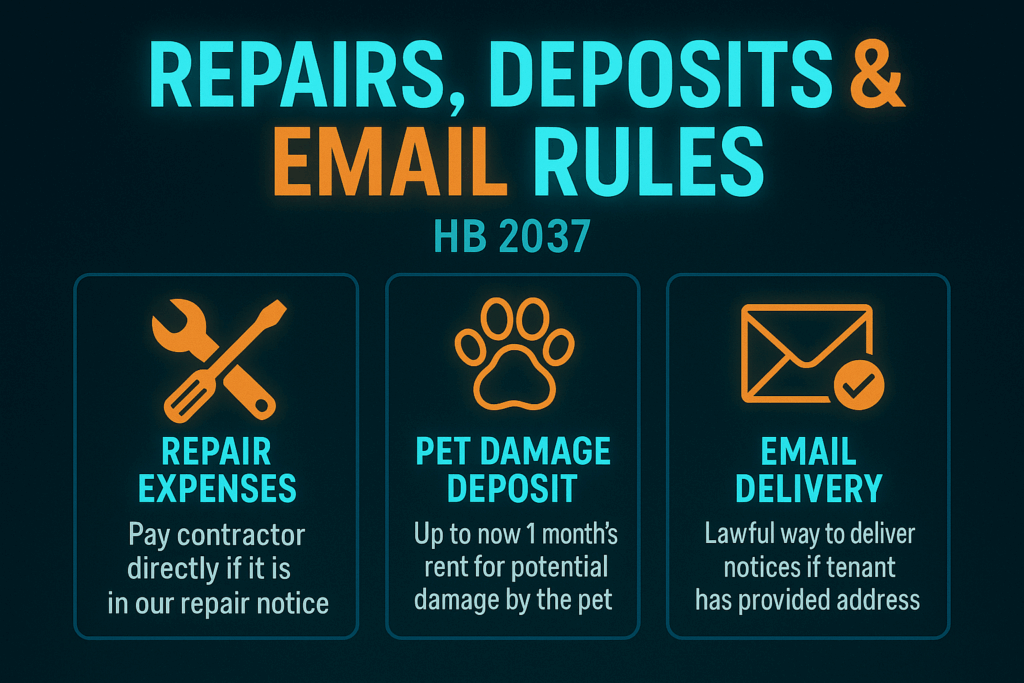
- If a tenant triggers the “repairs and remedies” section by sending you the proper notice, qualifying repairs now must be done by independent contractors who are licensed under local rules (where licensure is required). That’s a pretty strong nudge away from “my cousin can fix it” in those situations.
- You can now use email to handle security deposit communications, if and only if email has already been used as a communication method between you and the tenant.
In practice, that means:
- For serious habitability issues, your “handyman-only” model may no longer cut it. Build a bench of properly licensed vendors for HVAC, electrical, plumbing, and structural work.
- Decide whether you want to standardize on email for deposit notices and confirmations. If you do, set the expectation early and consistently use that address throughout the tenancy.
6. Lease Terminations for Sexual Assault Victims (HB 47)
HB 47 expands protections for tenants who are survivors of sexual assault. Under the new rules, they can terminate a lease regardless of where the incident occurred, as long as documentation and timing requirements are met.
For landlords, this isn’t about “loopholes”; it’s about making sure your team doesn’t mishandle a sensitive, legally protected request.
What to put in place for 2026:
- A written internal procedure for handling early-termination requests based on family violence or sexual assault — who reviews them, what documentation is required under the statute, and how you respond.
- Basic training for office staff so they don’t argue or improvise in the moment. The wrong comment in an email can create a bigger problem than the lost rent ever would.
7. Texting Tenants & Prospects: SB 140
If your leasing office loves mass texts, SB 140 should be on your radar. It clarifies that “telephone solicitation” rules now explicitly cover SMS/MMS and other digital messages and ties violations to DTPA lawsuits with statutory damages per message.
There are exemptions for existing customers and some other categories, and TAA has baked “prior express consent” language into its lease forms, but this is not the year to let your marketing intern blast unvetted text campaigns.
2026 to-dos:
- Audit your texting platforms and make sure they’re only being used in ways that qualify for exemptions or that have clear written consent.
- Coordinate with your attorney or association on opt-in language in applications and leases.
8. So… How Do You Turn All This Into a 2026 Game Plan?
Here’s a simple way to make this manageable instead of overwhelming:
- Sit down with a Texas-focused attorney or your association (TAA/AAGD, etc.).
Ask them specifically about SB 38, SB 1333, SB 17, SB 2349, HB 2037, HB 47, and SB 140 as they apply to your portfolio.
- Update your paperwork.
Lease templates and addenda (flood disclosures, SB 17 questions, marketing/text consent).
Nonpayment notices and eviction packets under SB 38.
Internal “how-to” sheets for repairs & remedies, early terminations, and suspected squatters.
- Train your people.
Even if “your people” is just you and a part-time bookkeeper, make sure everyone who talks to tenants or prospects knows:
What you can and can’t promise
When to say, “I’ll get back to you in writing”
When to call your lawyer before hitting send
- Document everything.
Keep clear records of notices, disclosures, repair requests, responses, and payment plans.
If something ends up in court, paper beats memory every time.
One Last Thing
This article is a high-level roadmap, not legal advice. Texas law is changing fast, and some details will depend on your city, your lease forms, and your specific situation. When in doubt, pick up the phone and talk to someone whose job isto live in the weeds of the Property Code.
But if you walk into 2026 with your eyes open to these new rules, you’ll be miles ahead of the landlord who doesn’t find out about SB 38 or SB 1333 until after a judge or deputy is already involved.