

This Content Is Only For Subscribers
Holiday season is peak chaos: shortened office hours, travel, weather, and a parade of deliveries. It’s also a time when notice mistakes turn simple issues into expensive disputes. Whether you’re entering a unit, changing a policy, posting a rent increase, serving a non-renewal, or scheduling repairs, how and when you give notice matters as much as what you say.
Here’s a practical, holiday-specific guide to staying fair, timely, and defensible.
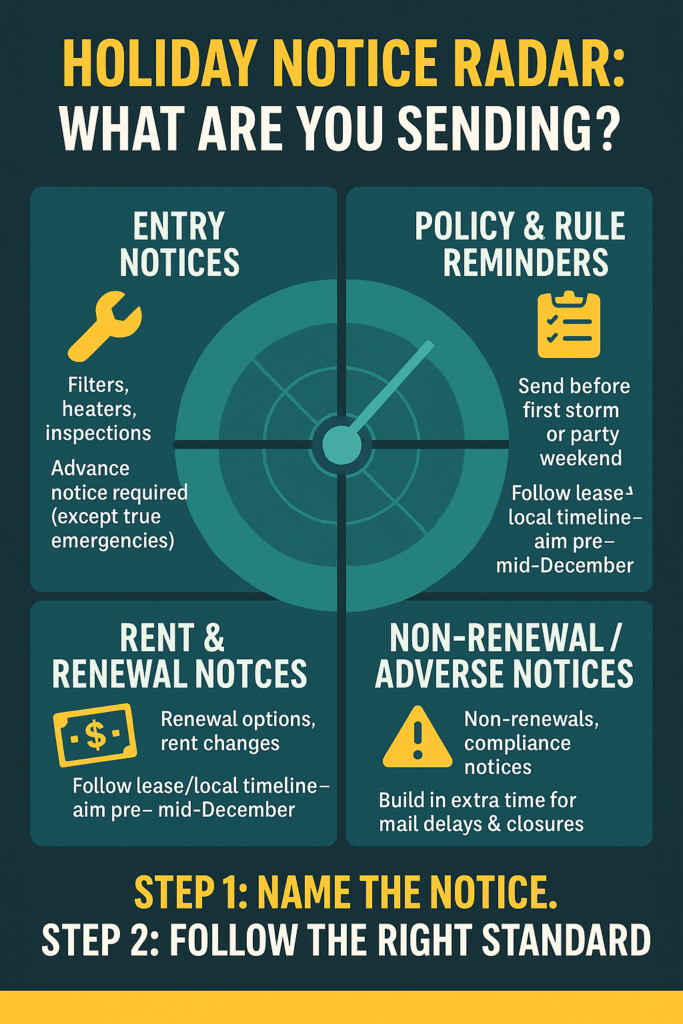
Know which notice you’re giving (and the standard it follows)
- Entry to perform work or inspections. Most leases require advance notice except in true emergencies. Holidays don’t erase that. If you’re doing preventive maintenance (filters, heaters, leak checks), schedule it with written notice and a clear window.
- Policy and rule reminders. Seasonal rules (decor, space heaters, parking, package handling) should be distributed in writing well before the first storm or party weekend.
- Rent changes and renewals. Renewals or increases need lead time defined by your lease or local rule. Aim to deliver before mid-December so residents can decide without last-minute pressure.
- Non-renewal or adverse notices. When you must deliver a non-renewal or other time-sensitive notice, assume mail slowdowns and office closures will chew up days. Build in extra time.
Calendar realities: business days vs. calendar days
Holidays skew timelines. If a rule or lease says “X days,” confirm whether that means calendar days or business days. Then map out:
- Observed holidays. Many timelines pause when offices, courts, or mail services are closed.
- Weekend drift. If your deadline lands on a Sunday or a holiday, identify what “next day” means under your lease or standard practice—and write it down on the notice.
When in doubt, over-deliver on time: send earlier, use multiple delivery methods, and document receipt.
Delivery methods that hold up
Use at least two methods in December:
- Primary method required by your lease (hand delivery, certified mail, posting, portal message—whatever your contract specifies).
- Redundant confirmation (email + text with a read receipt, resident portal notification, or photo of the posted notice with a timestamp).
For posted notices, photograph the door, the notice, and the unit number in one frame. For mailed items, keep the receipt and tracking page. For electronic notices, export the portal log or screenshot the “delivered/read” status.
Tone and clarity win disputes before they start
A fair notice is short, specific, and free of emotion. Lead with facts and include:
- The what: “Entry to replace furnace filter.”
- The when: Date and time window (e.g., 9–11 a.m.).
- The why: Safety, habitability, compliance, or lease requirement.
- The how to reach you: A live number for day-of coordination.
- The options: “If this window doesn’t work, reply by [time/date] for a new slot.”
Holiday tip: acknowledge the season. People are hosting, traveling, or working overtime. A single line—“We know schedules are tight; we’ll work with you”—lowers resistance and boosts cooperation.
Emergencies vs. urgent-but-not-emergencies
- Emergencies (active leaks, gas smell, fire/smoke events, no heat during a freeze, dangerous electrical faults) allow immediate entry. Leave a written notice afterward describing the event, time on site, and actions taken.
- Urgent-but-not-emergencies (weak heat, slow drains, intermittent power) still need notice. Offer the soonest window, but keep it inside normal rules unless conditions escalate.
If you must enter when the resident is away, leave a door tag and a same-day email/text recap.
Fairness across residents
Apply the same lead times and delivery methods to similar situations. If one resident gets 24 hours’ entry notice and another gets 6 hours for the same task, you’ve created a perceived fairness problem—even if both are technically allowed. Standardize:
- Entry notice windows (e.g., 24 hours for routine, 48 hours for non-urgent interior projects).
- Policy reminder cadence (e.g., send seasonal rules by Nov 1, then a friendly nudge Dec 1).
- Response times (e.g., “We answer notice-related questions same business day”).
Consistency is the best defense against complaints of selective treatment.
Sample language you can adapt
Routine entry (filters/heaters):
“We will enter [Unit #] on [Date] between [Time–Time] to replace your furnace filter and check heater operation. This visit averages 10 minutes. If you need a different time, reply by [Date/Time] and we will reschedule. Thank you for helping us keep your home safe and warm.”
Policy reminder (decor/electrical):
“Holiday safety reminder: keep exits clear, use only listed LED lights, no cords across floors, and turn lights off by 10 p.m. These neutral rules apply to all decorations and prevent trip/fire hazards. Questions? Text or email—happy to help.”
Non-renewal/renewal deadline nudge:
“Your lease ends [Date]. Please choose a renewal option or confirm move-out by [Date]. If we don’t hear from you, we’ll proceed per the lease. We’re available to discuss terms this week.”
Accounting for travel and package season
- Travel: Many residents are away; say so in your notice: “If you’ll be out of town, reply with travel dates so we can schedule after your return, unless it’s an emergency.”
- Packages: Don’t post notices over peepholes or where they can be covered by deliveries. If your building has lockers or an office hold, remind residents to check the portal for notices.
When residents don’t respond
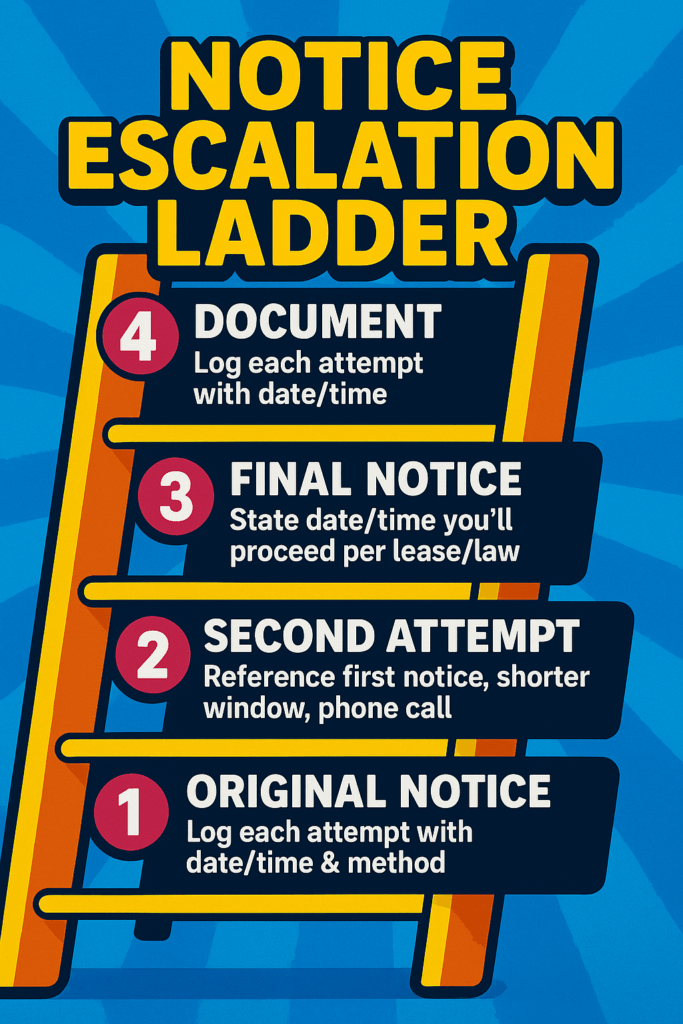
Escalate predictably:
- Original notice (primary + redundant channel).
- Second attempt referencing the first, with a shorter window and a live phone outreach.
- Final notice stating the time you will proceed consistent with the lease and law (or documenting why you cannot proceed without access).
Log each attempt with timestamps and screenshots. If you miss access due to no response, bill the trip charge only if your lease allows and your practice is consistent.
Internal logistics that make notices work
- Holiday staffing plan. Publish on-call rotations and escalation paths so notices include real, reachable contacts.
- Court/office calendars. Note closure dates; adjust any legal or lease timelines accordingly.
- Template bank. Keep entry, policy, renewal, and non-renewal templates ready with merge fields (name, unit, date, window, purpose).
- Quality check. Before sending, confirm unit number, names, and dates. A wrong door tag ruins credibility fast.
The bottom line
Fair notice during the holidays is equal parts timing, documentation, and tone. Map your calendars, use two delivery methods, be clear about what and why, and offer a reasonable path to reschedule. Treat like cases alike, move fast on true emergencies, and keep a clean paper trail. Do that, and you’ll protect residents’ quiet enjoyment—and your own peace of mind—during the busiest weeks of the year.


