This Content Is Only For Subscribers
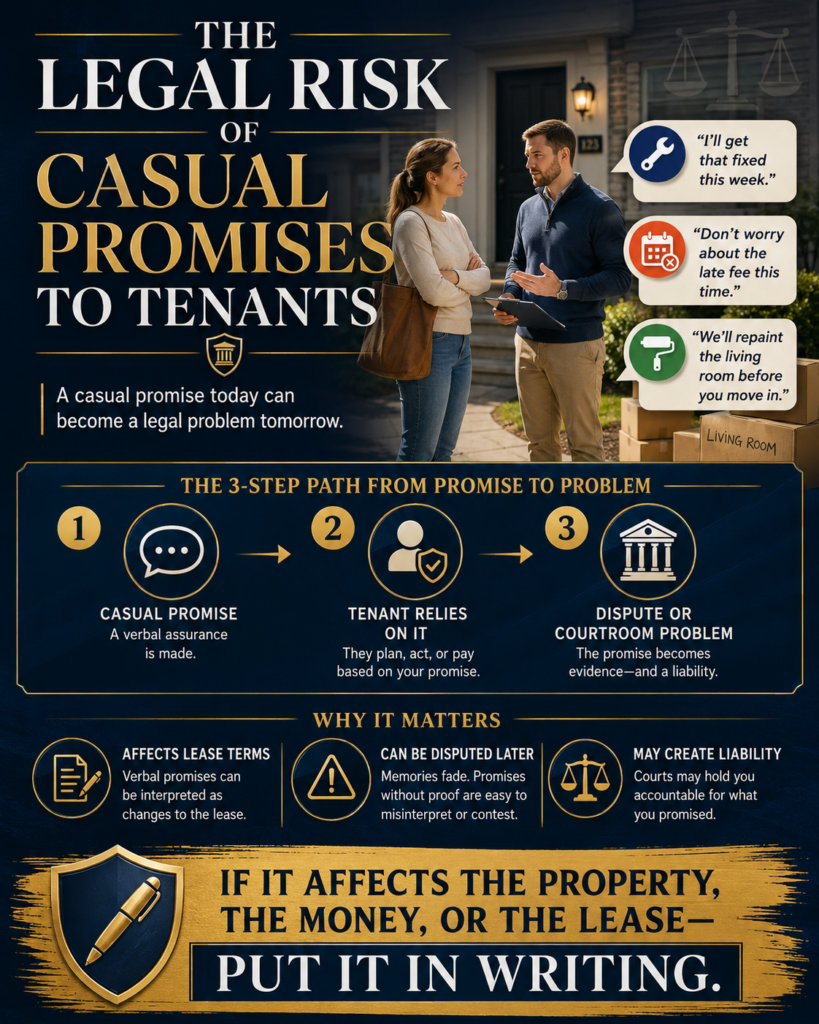
Every landlord has made a casual promise at some point. You are standing in the driveway during a move-in walkthrough and the tenant mentions the kitchen faucet drips. You say, “I’ll get that fixed for you this week.” You are on the phone with a tenant who is short on rent and you say, “Don’t worry about the late fee this time.” You are showing a unit and you say, “We’ll repaint the living room before you move in.”
These statements feel like minor courtesies. They are legally significant commitments that can be used against you in a Texas courtroom if they are not fulfilled or later disputed. The casual promise is one of the most common and most preventable sources of legal liability for independent landlords in Texas.
Why Verbal Promises Create Legal Exposure
A lease agreement is a contract. In Texas, the standard Texas Association of Realtors Residential Lease contains a merger clause stating that the written document represents the entire agreement between the parties and supersedes all prior verbal representations. This clause is designed to protect both parties by establishing a clear, definitive record of their obligations.
However, verbal promises made after the lease is signed can operate as modifications to that contract, particularly when a tenant relies on those promises to their detriment. This legal concept, known as promissory estoppel, allows a court to hold a party to a verbal promise when the other party reasonably relied on that promise and suffered harm as a result of it not being fulfilled.
Consider the repaint scenario. A landlord verbally promises to repaint the living room before move-in. The tenant signs the lease and moves in without the repaint being completed. The tenant later withholds a portion of rent, claiming the landlord failed to fulfill a material promise that induced them to sign the lease. In a Justice of the Peace court, the landlord has no written evidence of the specific terms of that promise, whether it was conditional, what timeline was discussed, or whether the tenant acknowledged the issue was resolved. The landlord is now defending a verbal commitment they may not even clearly remember making.
The Specific Promises That Carry the Highest Risk
Not all casual promises carry equal legal weight. The promises that create the most significant liability are those that relate to the condition of the property, the financial terms of the tenancy, or the specific obligations of either party under the lease.
Promises about repairs and property condition are particularly dangerous. When a landlord promises to fix a specific condition before or during the tenancy, that promise can be construed as a warranty of habitability or a material inducement to the lease. If the repair is not completed, the tenant may have grounds to argue the landlord breached a material term of the agreement, potentially justifying rent withholding or early lease termination under Section 92.056 of the Texas Property Code.
Promises about financial accommodations are equally risky. A landlord who verbally waives a late fee, agrees to accept partial rent, or promises not to enforce a specific lease provision has potentially modified the financial terms of the contract without documentation. When the landlord later attempts to enforce the original lease terms, the tenant can raise the verbal modification as a defense, and without written evidence to the contrary, the landlord’s position is difficult to defend.
Promises made before the lease is signed carry a distinct category of risk. Representations about amenities, planned improvements, or the condition of specific systems that induce a tenant to sign can be treated as fraudulent misrepresentation if they are not fulfilled, even when made casually and without intent to deceive.

The Discipline Required to Protect Yourself
The solution is not to stop being helpful or accommodating to your tenants. It is to ensure that every commitment you make is immediately documented in writing. This discipline requires a shift in how you think about routine conversations with tenants.
Before you make any promise about a repair, a financial accommodation, or a property condition, ask yourself whether you are prepared to document it. If you tell a tenant you will repaint the living room, send an email that same day confirming the commitment, specifying the timeline, and noting any conditions. If you agree to waive a late fee, send a written confirmation explicitly stating that the waiver applies to the current month only and does not alter the ongoing terms of the lease.
This approach does not make you a difficult or legalistic landlord. It makes you a professional one. Tenants who receive written confirmations of verbal commitments are not alarmed by the formality; they are reassured by it. And when a dispute arises, as disputes inevitably do in property management, your written record of every promise you made and every accommodation you granted is the difference between a defensible position and an expensive lesson.