This Content Is Only For Subscribers
At some point, every self-managing landlord reaches the same breaking point. It is 9:30 on a Sunday night and a tenant is texting about a loose cabinet hinge. You are at your kid’s soccer game and your phone buzzes with a question about where to park a second vehicle. You are sitting down to dinner and a message comes in asking whether the lease allows a small fish tank.
None of these are emergencies. All of them feel urgent to the tenant sending them. And if you have trained your tenants to expect a response at any hour of the day, you have nobody to blame but yourself.
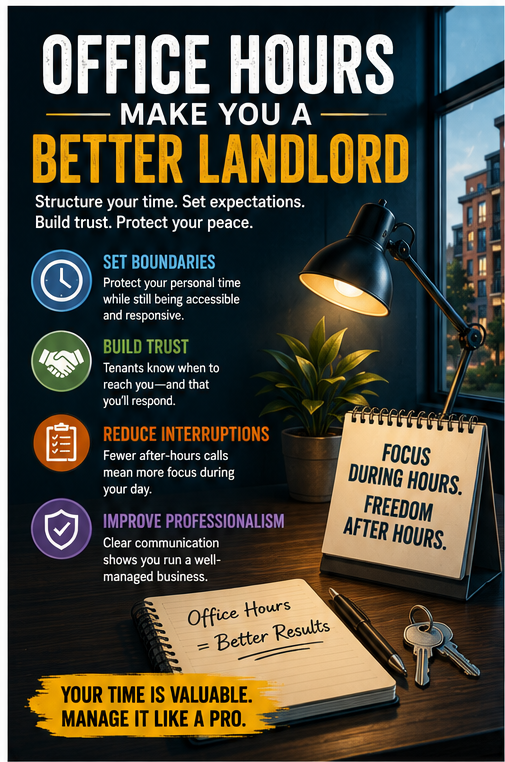
Setting office hours is the single most effective boundary a landlord can establish. It protects your personal time, it professionalizes the relationship, and it actually improves the tenant experience when it is done correctly. The landlords who resist it almost always do so because they are afraid of seeming unavailable or uncaring. That fear is misplaced.
Why Office Hours Make You a Better Landlord
When you are reachable at all hours, you are never fully present anywhere. You are half-distracted at dinner, half-checked-out at your kid’s game, and half-asleep when you finally put the phone down at midnight. That constant low-grade availability does not make you a more responsive landlord. It makes you a more exhausted one.
Office hours force you to batch your communication. Instead of responding to a trickle of messages throughout the day and evening, you handle them during a defined window when you are focused and professional. Your responses are better. Your decisions are clearer. And because you are not resentful from being interrupted at 10 PM, your tone is warmer.
Tenants, despite what many landlords assume, do not actually need you available around the clock. What they need is confidence that when they reach out, they will hear back. Office hours deliver that confidence through a clear, reliable promise rather than an unpredictable, on-demand response.
How to Frame the Hours
The language you use to communicate your office hours matters more than the hours themselves. There is a significant difference between “I don’t respond after 6 PM” and “My business hours are Monday through Friday, 9 AM to 6 PM, and I respond to all messages within one business day.”
The first version sounds like a restriction. The second sounds like a service standard. Both communicate the same boundary, but only one of them leaves the tenant feeling like they are in good hands.
When you announce your office hours, pair them with a clear response time commitment. Telling a tenant that you respond within one business day sets an expectation they can rely on. It also holds you accountable. If you say you will respond within one business day, you need to actually do it, every time. Consistency is what builds trust, not availability.
The Emergency Exception
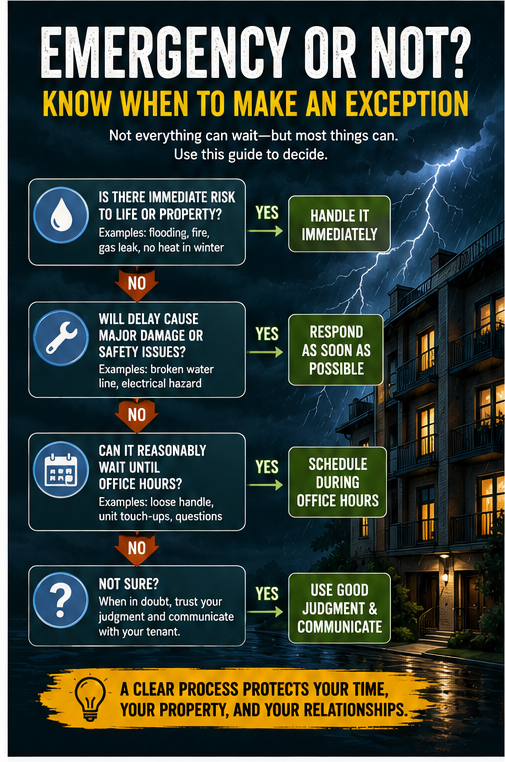
Office hours only work if you have a clear, well-communicated exception for genuine emergencies. If a tenant cannot reach you at 2 AM when a pipe bursts, you have a real problem. The emergency exception is not a loophole that undermines your office hours; it is what makes them credible.
Define emergencies specifically and include that definition in your welcome message, your lease addendum, and your voicemail greeting. A true emergency is any situation that poses an immediate risk to the tenant’s safety, causes active property damage, or involves a complete loss of a critical utility such as heat, air conditioning during extreme Texas summer temperatures, or running water.
A dedicated emergency line, separate from your main business number, is the cleanest way to handle this. Many landlords use a second Google Voice number with a voicemail greeting that states the emergency criteria clearly. If the situation qualifies, the tenant leaves a message and you call back. If it does not qualify, the greeting directs them to submit a standard maintenance request during business hours.
Putting It in Writing
Once you have established your office hours and your emergency protocol, put them in writing in at least three places: your welcome message to new tenants, your email signature, and your voicemail greeting. When the boundary is documented and visible, it is nearly impossible for a tenant to claim they did not know.
You are not being unhelpful by setting office hours. You are being professional. The landlords who are available for every minor question at every hour of the day are not providing better service. They are just providing more of it, at a significant personal cost, and usually with diminishing patience. Set the hours, communicate them clearly, and hold to them. Your tenants will adjust, and you will get your evenings back.