

This Content Is Only For Subscribers
If you manage more than a handful of doors, you’ve probably experienced the “First of the Month Pile-Up.” It’s that dreaded 48-hour window when three old tenants are moving out, four new tenants are moving in, the cleaning crew is running behind schedule, and your phone is vibrating right off your desk.
In Texas, where the leasing season is heavily concentrated around the summer months and the start of the school year, managing multiple simultaneous move-ins is a survival skill. If you try to handle each one individually, you will inevitably drop the ball, leading to frustrated new residents and a massive headache for yourself.
To survive the pile-up, you have to stop treating move-ins as individual events and start treating them like a manufacturing assembly line. Here is how you can batch-process your move-ins for maximum efficiency without losing that personal touch.
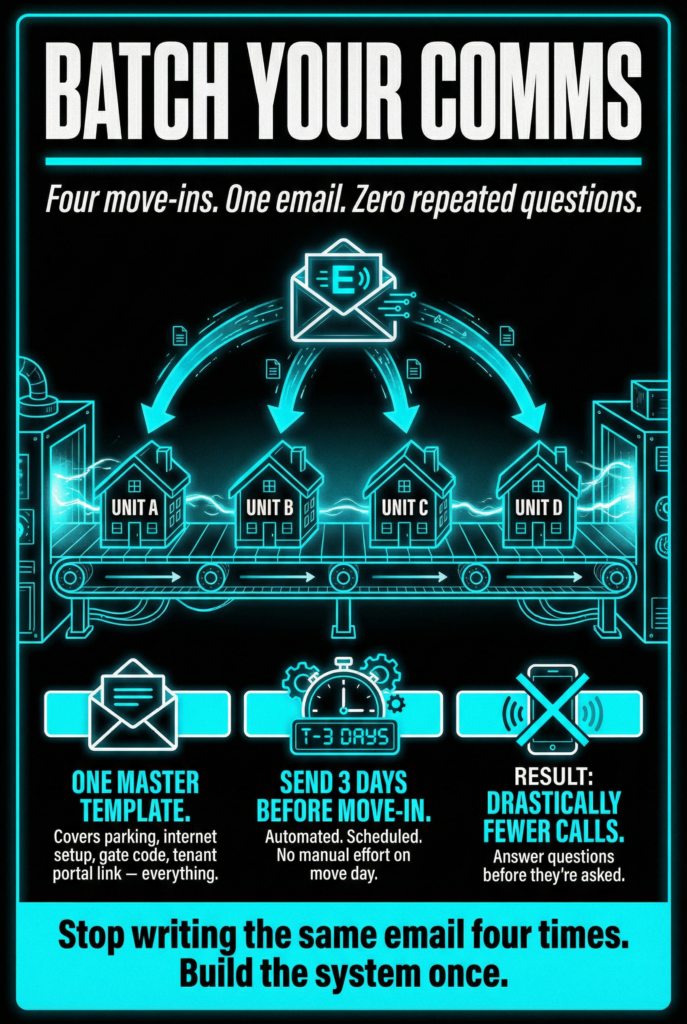
Batch Your Communications
When you have four tenants moving in on the same weekend, you cannot afford to write four separate “Welcome Home” emails or answer the same question about the trash schedule four different times.
You need to batch your communications. Create a single, comprehensive template for your move-in instructions. This email should include everything: where to park the moving truck, how to set up the internet, the gate code, and the link to the tenant portal.
Schedule this email to send automatically to all incoming tenants exactly three days before their lease begins. By proactively answering their questions all at once, you drastically reduce the volume of inbound texts and calls you receive on the actual day of the move.
Stagger the Key Handoffs
If you are still meeting tenants in person to hand over physical keys, you are setting yourself up for failure during a busy weekend. Tenant A gets stuck in traffic on I-35, which makes you late to meet Tenant B, who is now standing in the Texas heat with a U-Haul full of furniture.
You must eliminate the physical key handoff bottleneck.
The best solution is to install smart locks on your properties. Once the lease is signed and the deposit is paid, you simply generate a unique entry code for the tenant and schedule it to activate at 8:00 AM on their move-in day.
If smart locks aren’t in the budget, use secure, heavy-duty lockboxes. Place the keys in the lockbox a day early, and text the code to the tenant on the morning of their lease start date. This allows all four of your new tenants to move in simultaneously, on their own schedules, without requiring you to be in four places at once.
The “Make-Ready” Command Center
When you have multiple units turning over, you cannot rely on memory or sticky notes to track which unit needs what. You need a centralized command center.
Whether you use a sophisticated property management software or a simple, shared Google Sheet, you need a visual dashboard that tracks the status of every unit.
Your dashboard should have columns for:
•Move-Out Date
•Maintenance/Repairs Scheduled
•Painting Scheduled
•Cleaning Scheduled
•Carpet Cleaning Scheduled
•Move-In Date
This allows you to see at a glance if the painter is holding up the cleaner in Unit A, or if Unit B is completely ready for its new tenant. Share this dashboard with your core vendors so everyone is operating from the same playbook.
Pre-Position Your Move-In Packets
If you provide a physical welcome packet—perhaps a folder with community rules, some local takeout menus, and a branded pen or keychain—do not wait until the morning of the move to put them together.
Assemble all your welcome packets a week in advance. Keep them in a box in your car or your office. When your cleaning crew finishes a unit, have them place the welcome packet on the kitchen counter as their final step.
When the tenant walks in, the unit is spotless, the air conditioning is running, and their welcome packet is waiting for them. It feels incredibly personalized and welcoming, even though you batched the process days ago.

Embrace the Assembly Line
Managing multiple move-ins efficiently requires a shift in mindset. You have to move away from bespoke, individual hand-holding and embrace standardized, automated systems. By batching your communications, automating your key handoffs, and centralizing your vendor scheduling, you can handle the First of the Month Pile-Up with the calm precision of a seasoned pro.


