

This Content Is Only For Subscribers
In the business of real estate investing, every operational decision should be evaluated through a single lens: what is the return on this investment? Most landlords apply that lens to capital expenditures, debt structures, and market timing. Very few apply it to the quality of their tenant relationships. This is a significant miscalculation, because the financial value of a tenant who feels genuinely heard and respected is one of the highest-yield assets in a small portfolio.
The tenant who feels heard is not a soft concept. It is a measurable financial position. They renew their lease. They report maintenance issues early, before small problems become expensive ones. They treat the property with care. They pay on time without requiring reminders. They refer qualified applicants when they eventually move on. Each of these behaviors has a direct, quantifiable impact on NOI, and each of them is a direct product of how the landlord communicates.

The Renewal Premium
The most straightforward financial value of a tenant who feels heard is the renewal. In a competitive Texas rental market, the cost of tenant turnover is substantial. Make-ready expenses, leasing commissions, vacancy days, and the administrative burden of screening a new applicant can easily total $5,000 or more per turnover event. A tenant who renews eliminates all of those costs in a single decision.
A tenant who renews is also a known quantity. Their payment history is documented. Their treatment of the property is established. The investor who retains a reliable, long-term tenant is not just avoiding turnover costs; they are preserving the most valuable asset in their portfolio: a predictable, stable revenue stream.
The tenant who feels heard is the tenant who renews. They renew because when they reported a problem, it was addressed. They renew because the landlord treated them as a valued resident rather than a monthly transaction. That renewal decision is worth thousands of dollars to the investor’s bottom line.
The Early Warning System
The second major financial value of a tenant who feels heard is their willingness to communicate proactively about property conditions. This is the early warning system that separates investors who manage their Cap Ex strategically from those who absorb expensive emergency repairs.
A tenant who feels comfortable communicating with their landlord will report a slow drip under the kitchen sink the week it appears. A tenant who feels ignored, dismissed, or likely to be blamed for the issue will put a bucket under the sink and say nothing. The first scenario produces a $150 plumber visit. The second scenario produces a $3,500 subfloor replacement six months later.
The investor who cultivates a communication-friendly relationship with their tenants is effectively deploying a distributed inspection network. Every tenant becomes an early detection system for issues that, if caught early, cost very little to resolve and, if ignored, become major capital expenditures. The return on this network is measured in dollars not spent.
The Rent Increase Absorption Rate
The third financial value of a tenant who feels heard is their willingness to absorb rent increases. In a market where property taxes and insurance premiums in major Texas metros have escalated significantly, the ability to pass those cost increases through to the tenant without triggering a vacancy is a critical operational capability.
A tenant who has had a positive, communicative relationship with their landlord is far more likely to accept a reasonable rent increase than a tenant who has accumulated grievances. The increase is not evaluated in isolation; it is evaluated in the context of the entire tenancy experience. A tenant who has had every maintenance request addressed promptly, who has been communicated with professionally and respectfully, and who feels like a valued resident will absorb a fifty or seventy-five dollar monthly increase without serious resistance. A tenant who has felt ignored and disrespected will use the rent increase as the final justification for a departure decision they had already been considering.
The Compounding Effect
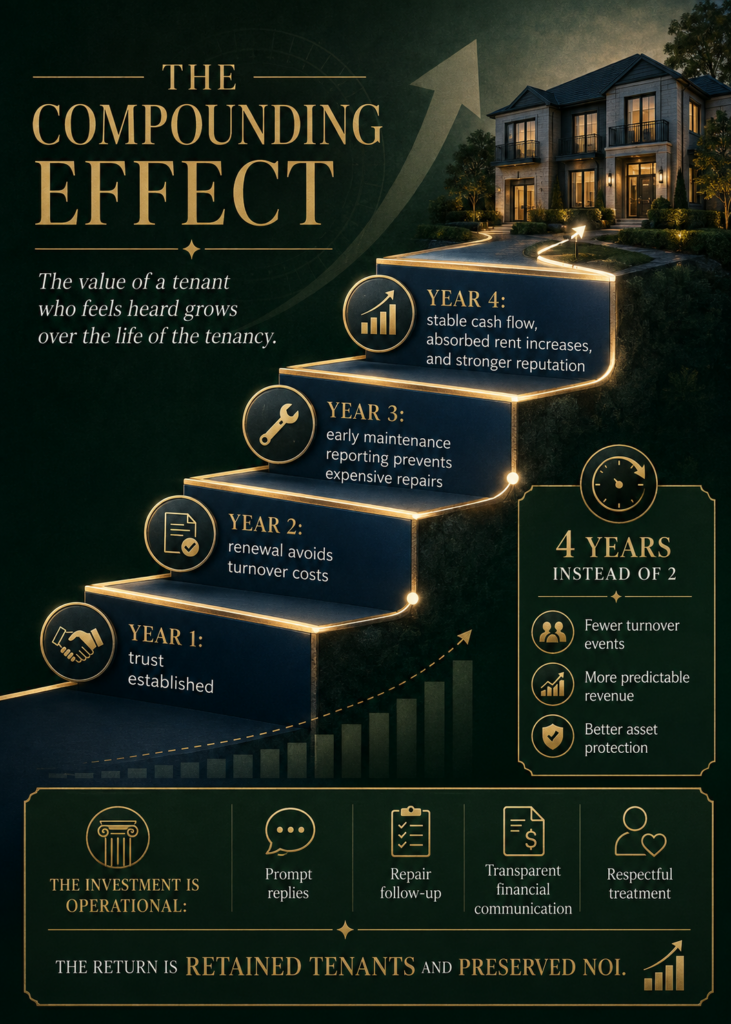
The financial value of a tenant who feels heard is not a one-time event. It compounds over the life of the tenancy. Every lease renewal, every early maintenance report, every absorbed rent increase, and every referral builds on the last. An investor who retains a high-quality tenant for four years instead of two has not just avoided two turnover events. They have preserved years of stable, predictable cash flow, protected the physical condition of the asset, and built a reputation in the local market as a landlord worth renting from.
The investment required to produce this outcome is not financial. It is operational. It is the consistent practice of acknowledging messages promptly, following up after repairs, communicating transparently about financial changes, and treating every tenant interaction as an opportunity to reinforce the relationship. The return on that investment, measured in retained tenants and preserved NOI, is one of the most compelling in the entire business of real estate.


