

This Content Is Only For Subscribers
The summer leasing season is a high-stakes environment for Texas property managers. The sheer volume of concurrent move-ins and move-outs creates an administrative bottleneck where procedural rigor is often sacrificed for speed. It is during this chaotic period that the seeds of future legal disputes are most frequently sown.
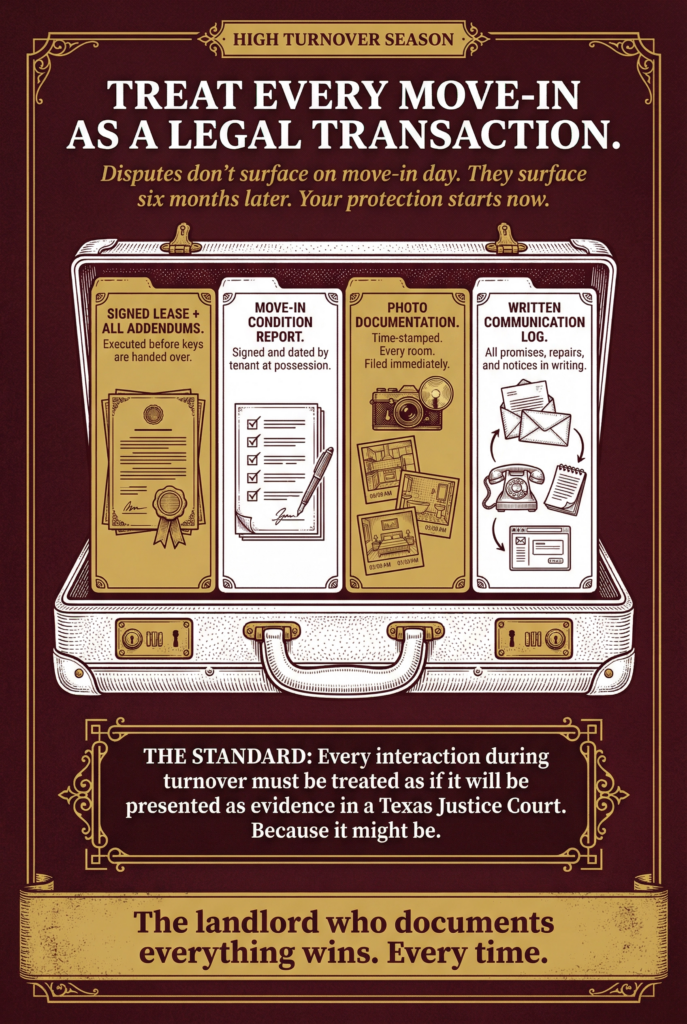
A dispute rarely materializes on the day a tenant moves in. It typically surfaces months later, triggered by a maintenance issue, a lease violation, or a security deposit deduction. When that conflict arises, the outcome is almost entirely determined by the documentation and communication established during the initial turnover. To insulate your business from liability, you must treat every interaction during this period as a formal legal transaction.
The Danger of Verbal Agreements
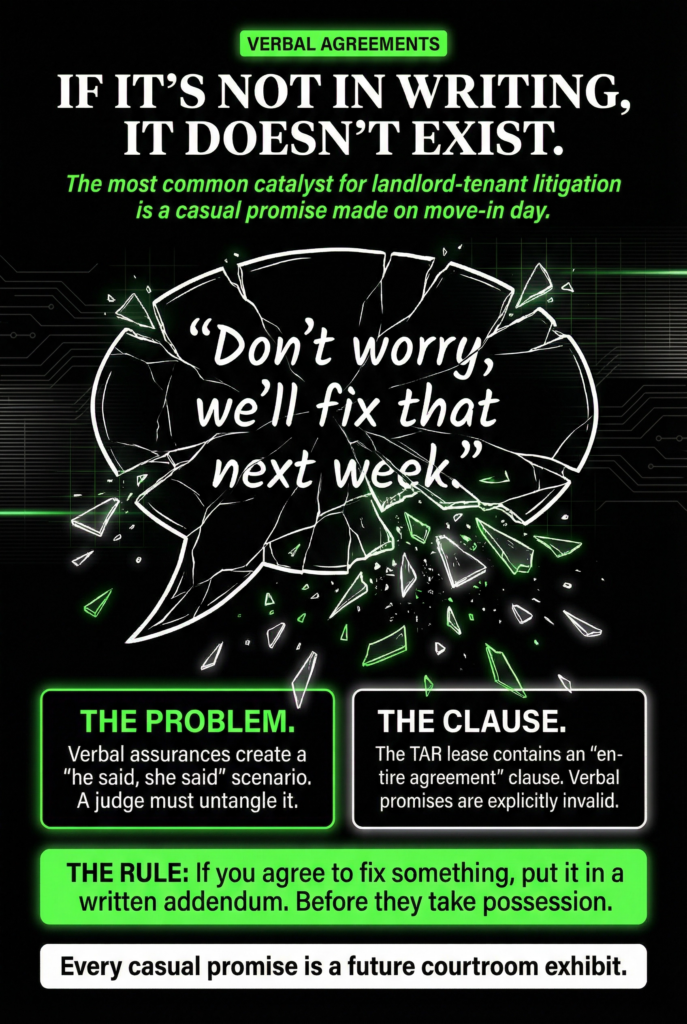
The most common catalyst for landlord-tenant litigation is the verbal agreement. During a hectic move-in day, a new tenant might point out a scuffed baseboard or a slow-draining sink. In the interest of keeping the process moving, a landlord might casually say, “Don’t worry, we’ll get someone out to fix that next week,” or “I won’t charge you for that when you move out.”
In contract law, these verbal assurances are notoriously difficult to prove or disprove, creating a “he said, she said” scenario that a judge must untangle. Furthermore, most professionally drafted leases, including the Texas Association of Realtors (TAR) lease, contain an “entire agreement” clause. This clause explicitly states that the written lease constitutes the entire agreement between the parties and that any prior or contemporaneous verbal agreements are invalid.
To avoid this trap, you must institute a strict policy: if it is not in writing, it does not exist. If you agree to address a repair after the tenant takes possession, that agreement must be documented in a formal lease addendum or a written maintenance request system.
Establishing a Communication Protocol
Ambiguity in communication is another primary driver of legal disputes. When a tenant needs to report an emergency maintenance issue, or when a landlord needs to provide a notice of entry, the method of communication must be clearly defined and legally recognized.
Relying on text messages for official property management business is a significant legal vulnerability. Text messages are easily lost, difficult to organize into a cohesive timeline, and often lack the formality required for legal notices.
Your lease should explicitly state the acceptable methods of communication for official notices and maintenance requests. Ideally, this should involve a centralized property management software portal where all requests are time-stamped, categorized, and permanently archived. If you do not utilize a software portal, require all maintenance requests to be submitted in writing via email or certified mail. By funneling communication through a formal, documented channel, you eliminate disputes over whether or when a landlord was notified of an issue.
The Move-In Walkthrough as a Legal Baseline
As discussed in our previous articles, the move-in condition form is your primary defense against security deposit disputes. However, the process of completing that form is just as critical as the form itself.
During high turnover, landlords often leave the condition form on the kitchen counter for the tenant to complete independently. This practice relinquishes control over the establishment of the legal baseline. A tenant, particularly one rushing to unpack, may inadvertently overlook pre-existing damage, or conversely, they may aggressively document every microscopic flaw to protect their deposit.
To maintain control and ensure accuracy, the astute landlord conducts a joint walkthrough with the new tenant. This process allows both parties to agree on the property’s condition in real-time. If a minor defect is noted, it is documented immediately, signed off by both parties, and supported by photographic evidence. This collaborative approach significantly reduces the likelihood of a dispute at the end of the lease term, as the tenant has actively participated in establishing the baseline.
Proactive Conflict Resolution
The goal of professional property management is not merely to win legal disputes, but to prevent them from occurring in the first place. This requires a proactive approach to conflict resolution.
When a tenant raises a concern, whether it is a maintenance issue or a question about a lease term, respond promptly and professionally, even if the answer is no. Ignoring a tenant’s communication or responding defensively escalates minor issues into formal legal grievances.
By maintaining a professional demeanor, strictly adhering to written documentation, and clearly defining communication protocols, you transform the chaotic summer turnover period from a legal liability into a structured, legally sound operational process.


