

This Content Is Only For Subscribers
The real estate market is not a flat line; it is a series of peaks and valleys. For residential investors in Texas, the topography is extreme. The summer months—driven by the school calendar and corporate relocation cycles—represent a massive spike in demand. The winter months, conversely, are a deep valley where tenant movement grinds to a halt.
A casual landlord prices their properties the same way in November as they do in July, hoping for the best. A serious investor understands that maximizing Net Operating Income (NOI) requires a deliberate strategy of seasonal rent adjustments. You must charge a premium when the market allows it, and you must protect your occupancy when the market demands it.

The Summer Premium Strategy
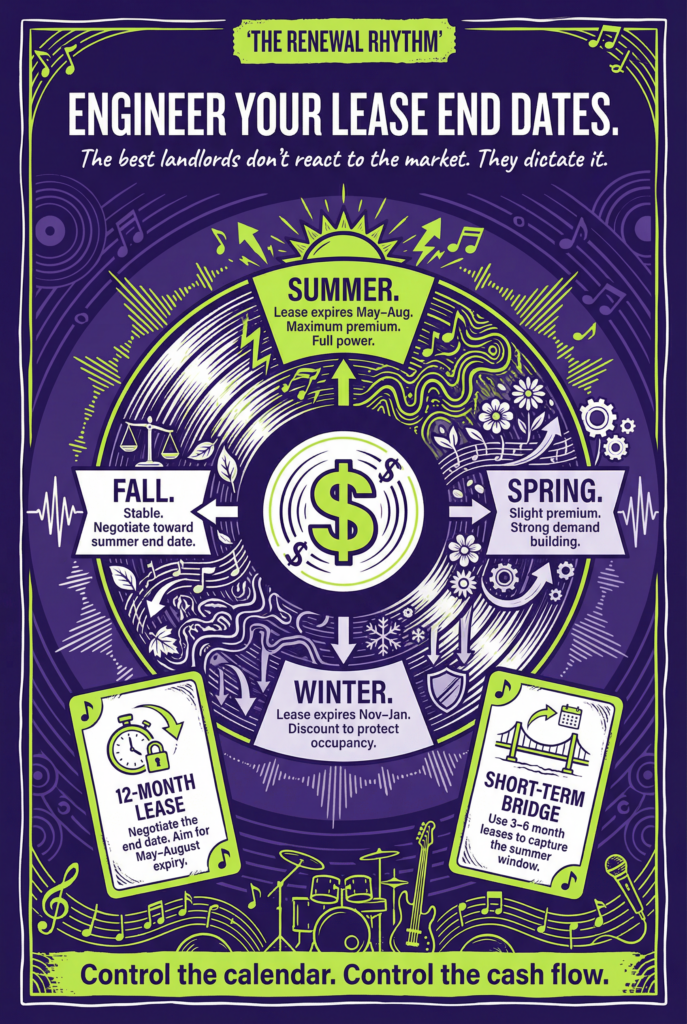
During the peak leasing window of May through August, your pricing strategy should be unapologetically aggressive. This is the only time of year when the balance of power shifts entirely to the owner.
When a property comes vacant in June, you are not just selling the physical space; you are selling the convenience of immediate occupancy during a frantic relocation season. A family moving to Austin in July is highly motivated to secure a home before the school year begins. They are far less price-sensitive than a single professional looking to move in January.
You must price this urgency into the rent. If your baseline comparable analysis suggests a rent of $2,000, your summer listing price should be $2,150. You are testing the absolute ceiling of the market. If you secure that premium, you have permanently elevated the cash flow of that asset for the duration of the lease. If the market rejects the premium after 72 hours, you simply stair-step the price down. The risk is minimal, but the potential upside is massive.
The Winter Discount Strategy
The inverse of the summer premium is the winter discount. When a lease expires in December, the demand side of the equation collapses. Nobody wants to move during the holidays.
If you attempt to hold firm to your aggressive summer pricing in December, you will almost certainly suffer an extended vacancy. A property that sits empty for two months while you chase an extra $50 in rent is a catastrophic failure of management.
During the winter valley, your primary objective shifts from maximizing yield to minimizing vacancy. If that same $2,000 property comes vacant in December, you should list it at $1,950 or even $1,900. You are offering a slight discount to the market to ensure the property leases immediately. Securing a reliable tenant at a $100 discount is infinitely more profitable than allowing the asset to bleed cash for 60 days.
The Power of the Lease Expiration
The ultimate goal of seasonal rent adjustments is not just to survive the winter, but to eliminate it entirely. As an investor, you have the power to dictate when your properties turn over by strategically managing your lease expiration dates.
If you are forced to sign a lease in November at a discounted winter rate, you must never offer a standard 12-month term. A 12-month lease simply guarantees that you will be negotiating your next turnover in the exact same low-demand valley next year.
Instead, offer a 6-month or an 18-month lease. By forcing the expiration date into May or June, you absorb the winter discount for a short period, but you position the asset to capture the summer premium on the next cycle.
The Renewal Conversation
Seasonal adjustments also apply to your existing tenant base. When a lease comes up for renewal in the summer, you hold the leverage. The cost and hassle for a tenant to move in the Texas heat is immense. You must present a renewal offer that reflects the current, inflated summer market rate. If the market rent has jumped to $2,300, a flat renewal is unacceptable. Offer $2,250—a slight discount to incentivize retention, but a significant increase to your NOI.
Conversely, if a lease expires in December, your leverage is gone. You want that tenant to stay. This is the time to offer a flat renewal or a nominal $25 increase. The cost of a winter turnover is far greater than the lost revenue of a missed rent hike.
Maximizing profits is not about charging the highest possible rent every single day of the year. It is about understanding the rhythm of the market and adjusting your strategy to capture the peaks and survive the valleys. By implementing seasonal rent adjustments, you transform your pricing from a static guess into a dynamic tool for wealth creation.


