This Content Is Only For Subscribers
The security deposit is the financial linchpin of the landlord-tenant relationship. It serves as your primary recourse against tenant-caused damage and unpaid rent. However, under Texas law, a landlord’s right to retain these funds is far from absolute. The ability to successfully and legally withhold a security deposit at the end of a lease term is almost entirely dependent on the actions taken at the very beginning—specifically, during the move-in inspection.
During the frenzied summer leasing season, when multiple units are turning over simultaneously, the move-in inspection is often treated as a mere formality. Landlords frequently hand over a blank condition form with the keys, assuming the paperwork will sort itself out. This approach is a critical legal error that routinely results in landlords losing deposit disputes.
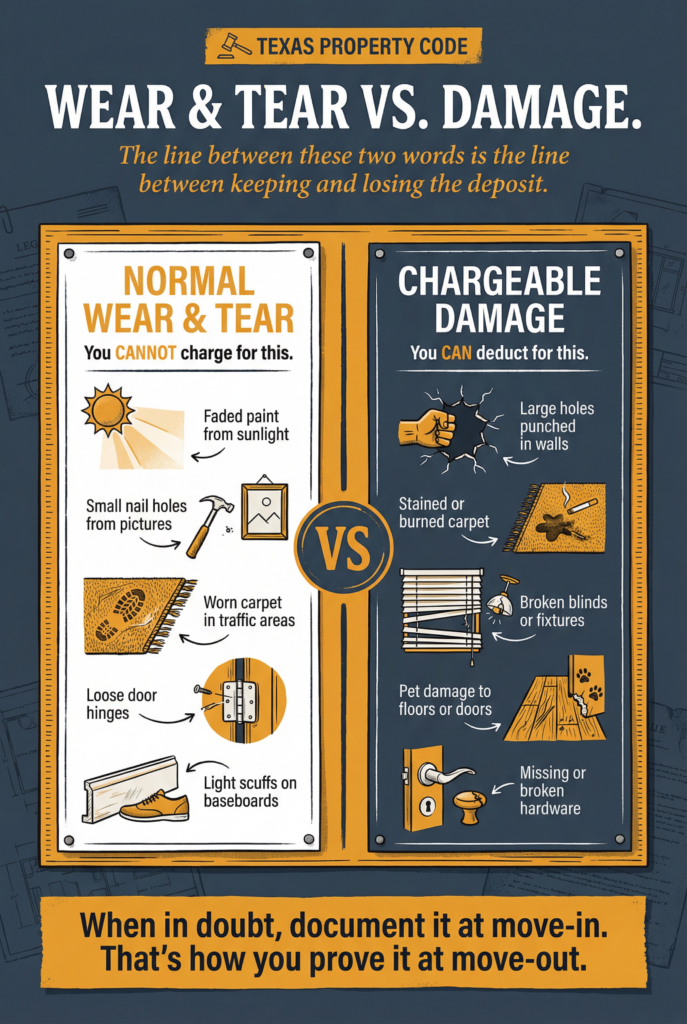
The Burden of Proof and “Normal Wear and Tear”
The central legal conflict in almost every security deposit dispute revolves around a single phrase: “normal wear and tear.” The Texas Property Code explicitly prohibits landlords from retaining any portion of a security deposit to cover deterioration that results from the intended use of a dwelling. You may only charge for damages that exceed this standard—such as negligence, carelessness, accident, or abuse.
When a tenant challenges a deduction, the legal burden of proof rests squarely on the landlord. You must be able to demonstrate, with compelling evidence, that the damage in question was not present when the tenant took possession and that it exceeds normal wear and tear. Without a meticulously documented baseline established at move-in, meeting this burden of proof is exceedingly difficult.
The Evidentiary Value of the Condition Form
The written move-in condition form is the foundational document for establishing this baseline. However, its legal utility depends entirely on its detail and execution. A form that simply lists “living room – okay” provides virtually no protection.
A legally defensible condition form must be granular. It should break down every room into specific components: flooring, baseboards, walls, ceiling, light fixtures, window coverings, and doors. It must note the specific condition of each item, including pre-existing damage, no matter how minor. If there is a half-inch scratch on the kitchen counter, it must be documented.
Crucially, this form must be signed and dated by the tenant. While Texas law does not explicitly mandate that a tenant return the form, a signed document constitutes an agreement on the property’s initial condition, making it incredibly difficult for the tenant to later claim that damage was pre-existing.
Implementing a Strict Deadline
During the summer rush, it is common for tenants to delay returning the condition form as they focus on unpacking. As a landlord, you cannot allow this to happen. You must establish and enforce a strict deadline for the form’s return.
Provide the form on the day of move-in and stipulate in writing—ideally within the lease agreement itself—that the form must be completed and returned within 48 to 72 hours. If the tenant fails to meet this deadline, document their failure in their file. Send a formal, written notice stating that because the form was not returned, the property is presumed to be in the condition noted by the landlord prior to move-in.
The Necessity of Photographic Evidence
In the modern legal landscape, a written condition form, while necessary, is often insufficient on its own. The astute landlord supplements the written record with comprehensive, time-stamped photographic and video evidence.
Before the new tenant moves a single box into the property, you or your property manager must conduct a thorough visual recording of the unit. This is not a quick walkthrough; it is an evidentiary gathering process.
Take wide-angle shots of every room to establish the overall condition, followed by close-up photographs of specific features, appliances, and any pre-existing damage. Ensure the date and time are clearly embedded in the metadata of the files.
When a dispute arises a year later over a gouged hardwood floor, a time-stamped photograph proving the floor was pristine at move-in is irrefutable. It transforms a subjective argument over “wear and tear” into an objective matter of fact.

Protecting Your Financial Recourse
The summer leasing season demands efficiency, but efficiency must never come at the expense of documentation. The few extra hours spent meticulously detailing a property’s condition and capturing photographic evidence may feel burdensome in July, but they are the only reliable mechanism for protecting your financial interests when the lease concludes.
By treating the move-in inspection not as a logistical chore, but as the critical first step in a formal legal transaction, you ensure that your right to retain a security deposit for legitimate damages remains legally defensible.