

This Content Is Only For Subscribers
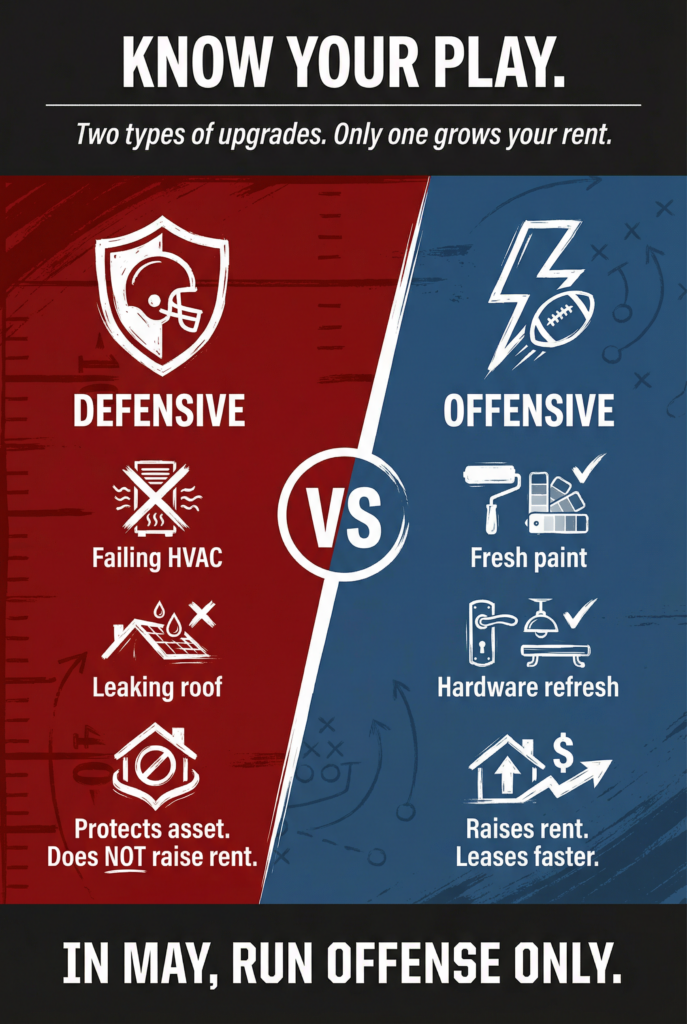
In the world of real estate investing, capital improvements fall into two distinct categories: defensive upgrades and offensive upgrades. A defensive upgrade—like replacing a failing HVAC system or patching a leaking roof—protects the underlying asset and prevents catastrophic loss, but it rarely allows you to increase the rent. An offensive upgrade is a calculated deployment of capital designed specifically to increase the perceived value of the property, drive up the monthly rent, and accelerate the leasing velocity.
As we approach the peak Texas summer leasing season, your focus should shift entirely to offensive, high-ROI minor upgrades. You do not have the time or the budget to gut-renovate a kitchen in May. But you do have the ability to execute targeted, low-cost improvements that will allow you to push your asking price to the absolute ceiling of the market. Here is where your capital should go.
The “First 30 Seconds” Upgrades
When a prospective tenant tours a property, their decision is largely made within the first thirty seconds of walking through the front door. Your upgrades should target this critical window.
The single highest-ROI upgrade you can make is a fresh coat of paint, but not just any paint. A landlord paints a wall “Navajo White” because it is cheap. An investor paints the walls a modern, cool-toned gray (like Sherwin-Williams “Agreeable Gray”) with crisp white trim because it instantly modernizes the space and photographs exceptionally well.
At a cost of $1,500 to $2,500 for a standard single-family home, modern paint can easily justify a $50 to $75 monthly rent increase. That equates to an additional $600 to $900 in annual Net Operating Income (NOI). At a 6% cap rate, that $50 rent increase just added $10,000 to the total valuation of your property. The math is undeniable.
The Hardware Refresh
The second highest-ROI category is the hardware refresh. Outdated, brass-toned doorknobs, cabinet pulls, and light fixtures instantly age a property by two decades.
For less than $500 in materials and a day of labor, you can replace every piece of visible hardware in the house with modern brushed nickel or matte black fixtures. This includes the front door handle, interior doorknobs, kitchen cabinet pulls, bathroom towel racks, and the primary light fixtures in the living room and dining area.
This upgrade is the definition of “cheap luxury.” It tricks the eye into perceiving a much more expensive renovation than actually occurred. When paired with modern paint, a hardware refresh allows you to market the property as “updated” or “modernized,” pushing your listing into a higher pricing tier and attracting a more affluent tenant pool.
The Texas Climate Advantage
In the brutal heat of a Texas summer, energy efficiency is not just an environmental concern; it is a massive financial selling point for tenants.
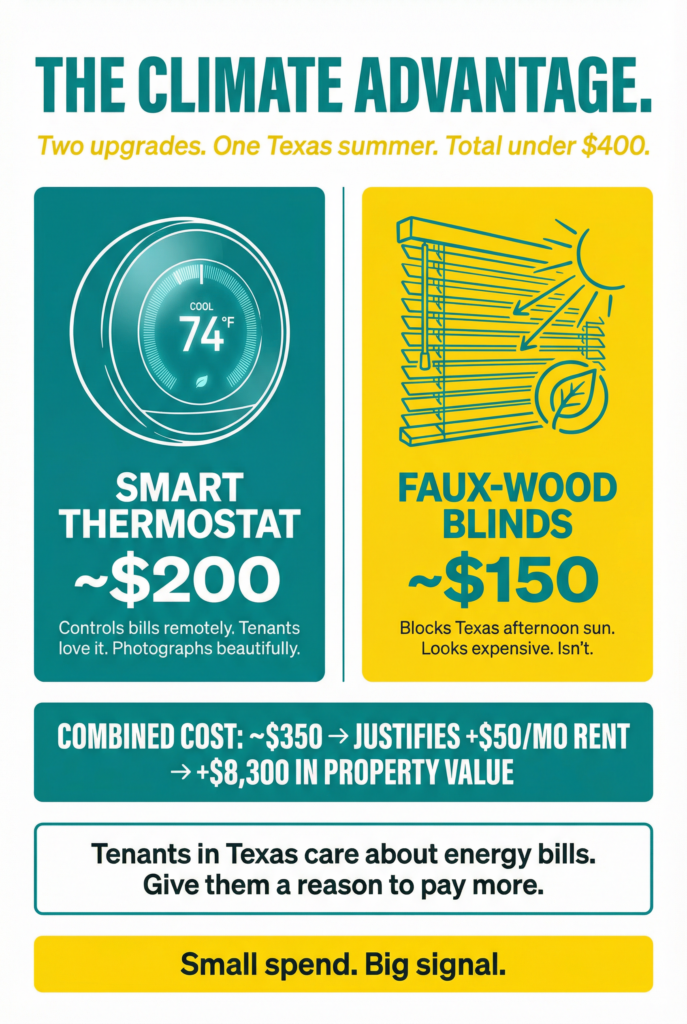
Installing a smart thermostat (like a Nest or an Ecobee) costs approximately $200. It takes fifteen minutes to install. Yet, it signals to the prospective tenant that the property is modern, efficient, and will help them control their summer utility bills.
Similarly, replacing cheap, broken plastic blinds with faux-wood, two-inch cordless blinds (approximately $40 to $60 per window) dramatically improves the aesthetic of the room while offering superior insulation against the afternoon sun. These are minor capital outlays that directly address the specific anxieties of a summer renter in Texas.
The ROI Calculation
Before executing any upgrade, you must run the ROI calculation. The formula is simple: (Annual Rent Increase / Cost of Upgrade) = ROI.
If you spend $3,000 on paint, hardware, and a smart thermostat, and those upgrades allow you to increase the rent by $100 a month ($1,200 annually), your cash-on-cash return for that specific investment is 40% ($1,200 / $3,000). You will recoup your entire investment in 30 months, and every dollar after that is pure profit.
More importantly, these upgrades drastically reduce your “Days on Market.” A modern, crisp, well-presented property will lease in three days during the summer peak, while a tired, dated property might sit for three weeks. If that three-week vacancy costs you $1,500 in lost rent, the upgrades essentially paid for themselves by preventing the vacancy in the first place.
As an investor, your goal is not to build your dream home; it is to build a highly efficient cash-flowing asset. By deploying small amounts of capital into high-impact, visible upgrades right before the summer rush, you maximize both your monthly yield and the long-term value of your portfolio.


