

This Content Is Only For Subscribers
When something breaks at 2 a.m., you’re not just fixing a building—you’re protecting people, property, and your reputation. Emergency repair calls are stressful because the stakes are high and the clock is loud. Here’s a calm, practical playbook you can run in your sleep.
First, define “emergency” (so everyone’s aligned)
Share this definition with residents at move-in and again each winter:
Emergencies typically include:
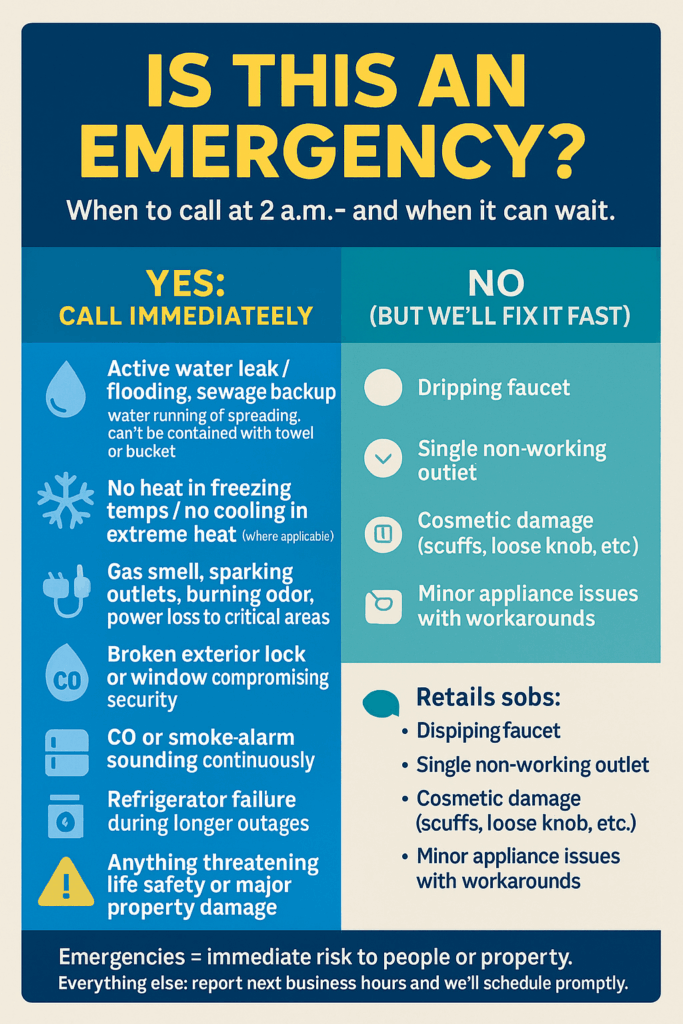
- Active water leaks/flooding, sewage backup
- No heat during freezing temps, no cooling during extreme heat (where applicable)
- Gas smell, sparking outlets, burning odor, power loss to critical areas
- Inoperable exterior door/lock, broken window compromising security
- Carbon monoxide or smoke alarm sounding continuously
- Refrigerator failure (food safety) for longer than a short outage
- Anything threatening life safety or major property damage
What’s not usually an emergency: Dripping faucet, single inoperable outlet, cosmetic damage. Those still get prompt attention—just not 2 a.m. attention.
The five-step emergency response
1) Stabilize over the phone (90 seconds or less).
Your first job is to reduce harm right now.
- Water: “Turn the supply off at the valve under the sink/toilet. If you can’t find it, use the unit’s main shutoff—tagged near the water heater.”
- Electric: “If you see sparks or smell burning, do not touch switches. Leave the unit and call emergency services.”
- Gas/CO: “Go outside immediately and call the gas company emergency line; then call me.”
- Security: “Stay at a neighbor’s or in your locked car. I’m sending a locksmith.”
2) Classify and clock it.
Log the time received, who called, what’s affected, and immediate risk (life safety / major damage / habitability). Start a visible countdown for yourself: you’ll update the resident within 30 minutes even if the vendor is en route.
3) Dispatch the right help.
Maintain a tiered vendor list—primary, backup, and last-resort—for each trade (plumber, HVAC, electrical, restoration, locksmith, roofer). After-hours numbers should be in your phone, not buried in email.
- Water/sewage active? Call plumber and mitigation/restoration (extraction + fans) right away. Waiting until morning multiplies cost and mold risk.
- No heat in a freeze? Call HVAC and consider dropping compliant space heaters with a safety sheet until the system is repaired.
- Electrical hazard? Electrician or emergency services first—then electrician.
4) Communicate like a pro.
Text a timestamped update:
“Plumber is dispatched, ETA 45–60 minutes. Please keep the water shut off and move belongings away from the leak. I’ll text you when they’re on site.”
If the ETA slips, say so—early. Silence is gasoline on anxiety.
5) Document and mitigate.
Photos, video, moisture readings if available, and written notes: where, when, how much, who responded, and what you authorized. Start a shared folder per incident. Mitigation (fans, dehumidifiers, tarps) should begin immediately after the hazard is controlled.
Access, approvals, and expectations
- Entry: Your lease should allow emergency entry with reasonable notice. Leave a door tag and an email recap after entry if the tenant isn’t home.
- Scope: Authorize the minimum work needed to stabilize and restore habitability overnight; schedule full repair during daylight when possible.
- Estimates: For non-life-safety items discovered during the visit, get an estimate—don’t approve major upgrades at 3 a.m.
- Belongings: Tenants move and protect personal items; vendors avoid moving high-value items without permission unless necessary to prevent damage.
Health, safety, and restoration
- Water events: The 48-hour mold clock is real. Extract, set equipment, and schedule a recheck. Replace saturated carpet pads; don’t “hope it dries.”
- Sewage backups: Treat as hazardous. Professional cleanup only; document disposal.
- Fire/smoke: After the fire department clears, secure the unit, board windows if needed, and evaluate electrical before re-energizing.
- Gas incidents: You don’t restore service; the utility does. Wait for their clearance.
Insurance and money talk (handle cleanly)
- Landlord policy: Some mitigation is covered—call the carrier early and log the claim number in your incident folder.
- Tenant renters insurance: Provide a neutral letter describing the event, timing, and affected areas. Don’t assign fault in writing unless you’re certain.
- Who pays tonight: You approve stabilization; final responsibility (tenant vs. owner vs. common element) is sorted after documentation and, if needed, adjuster review.
After-hours playbook items to prep now
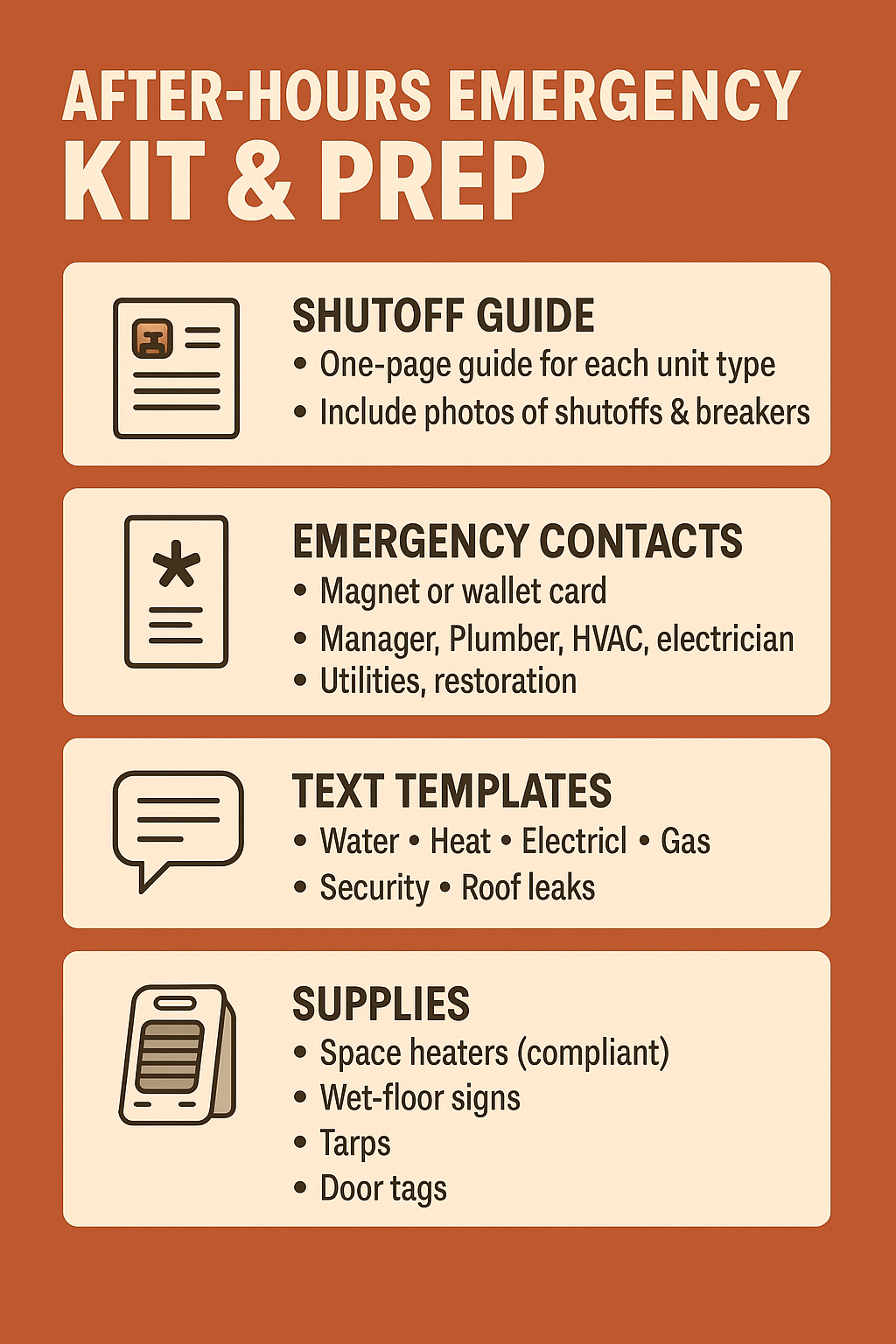
- A one-page “Find Your Shutoffs & Breakers” sheet with photos for each unit type
- Magnet or wallet card with emergency numbers (manager, plumber, HVAC, electrician, gas/electric utility, restoration)
- Prewritten text templates for water, heat, electrical, gas, security, and roof leaks
- A small cache of space heaters (compliant), wet-floor signs, tarps, and door tags
- A rotation or vendor SLA: response within 60 minutes for water/electrical, 90 minutes for HVAC in freezing temps
Close the loop—and learn
Within 24 hours, send a recap:
“Thanks for reporting quickly last night. The plumber stopped the leak at 1:12 a.m., mitigation set fans at 2:05 a.m., and we’ll return tomorrow at 10 a.m. to replace the supply line and baseboard. Please keep bathroom door open and fans running.”
Then conduct a micro–post-mortem: What failed? What could prevent a repeat (insulation, valve replacement, scheduled service)? Update your vendor list and your “shutoff” guide if anything was unclear.
The calm center
Emergencies feel chaotic to tenants. Your steadiness—clear steps, fast dispatch, honest ETAs, and meticulous follow-through—turns chaos into a process. Stabilize first, communicate often, document everything, and move from triage to repair to prevention. Do that, and the 2 a.m. call becomes a story of competence instead of crisis.


