

This Content Is Only For Subscribers
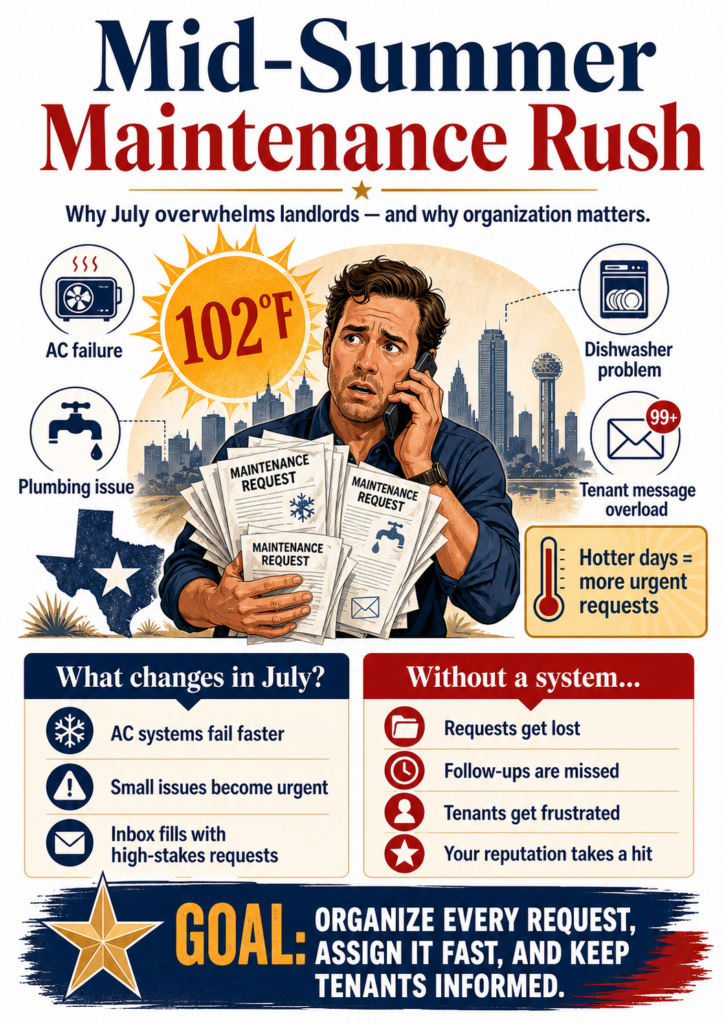
If there’s one thing every Texas landlord knows, it’s that July doesn’t care about your weekend plans. When the temperature hits 102 degrees for the twelfth day in a row, systems that worked perfectly fine in April suddenly decide to give up the ghost.
During the mid-summer rush, your inbox isn’t just full—it’s full of urgent, high-stakes problems. If you don’t have a system for organizing and tracking these maintenance requests, you’ll end up playing a frantic game of whack-a-mole, inevitably forgetting something important until an angry tenant calls to remind you. Let’s talk about how to organize the chaos so you can keep your properties running and your sanity intact.
The Problem with the “Sticky Note” System
When you only have one or two properties, it’s tempting to manage maintenance requests informally. A tenant texts you about a running toilet, you write it on a sticky note, you call your plumber, and you throw the note away when it’s fixed.
But what happens when you have five active requests across three different properties? What happens when the AC goes out at one house, the dishwasher breaks at another, and a third tenant is asking for permission to paint the living room—all on the same Tuesday? The sticky note system collapses. You forget to follow up with the HVAC tech, the tenant sits in a hot house for an extra day, and your reputation as a reliable landlord takes a hit.
Move Everything to a Central Dashboard
The only way to survive the mid-summer maintenance surge is to move every single request onto a centralized digital dashboard. If you use property management software like Buildium or TenantCloud, this is built in. If you don’t, you need to create a dedicated Google Sheet or use a free tool like Trello.
Your dashboard needs to track five critical pieces of information for every request:
1.The property address and tenant name
2.The exact nature of the problem (with photos if possible)
3.The date the request was submitted
4.The assigned vendor
5.The current status (New, Vendor Assigned, Parts Ordered, Complete)
When a tenant texts you a maintenance issue, your immediate response should be to log it on the dashboard. Do not rely on your memory. If it’s not on the board, it doesn’t exist.
The Daily Maintenance Huddle
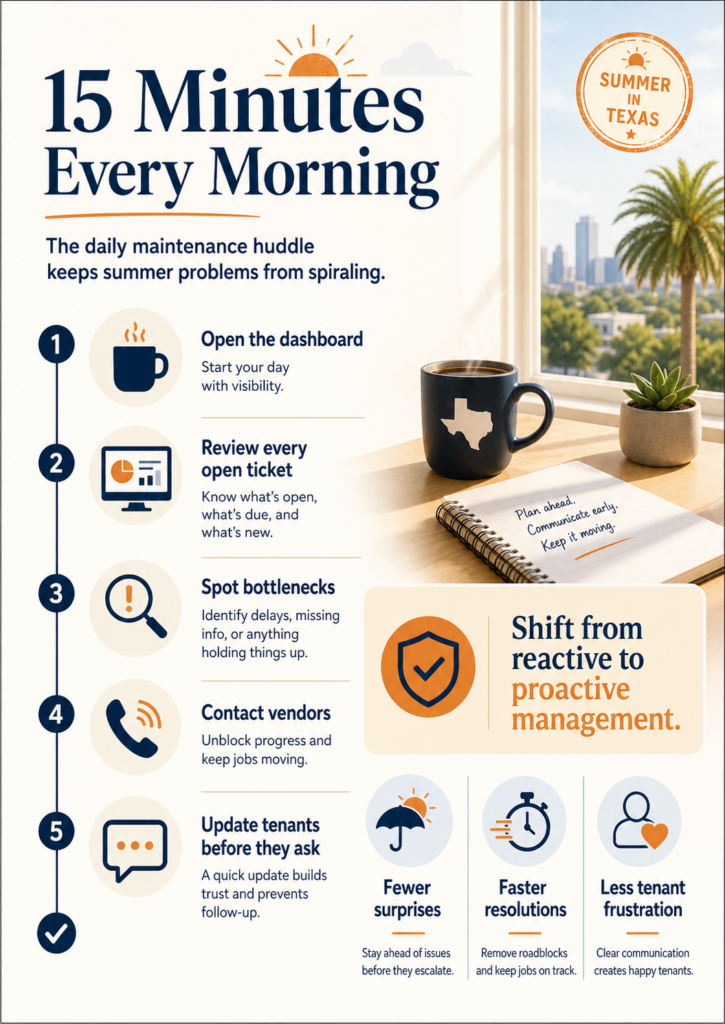
During the peak summer months, I recommend setting aside 15 minutes every single morning for a “maintenance huddle”—even if you’re the only person on your team.
Open your dashboard, grab your coffee, and review every open ticket. This is when you catch the bottlenecks. Did the plumber say he was going out yesterday, but the ticket still isn’t marked complete? Call him. Is the HVAC tech waiting on a part for unit 4B? Text the tenant an update so they know they haven’t been forgotten.
By reviewing the entire board every morning, you shift from reacting to problems as they blow up to proactively managing them before the tenant even has to ask for an update.
Grouping by Geography and Trade
When you’re staring at a board with six open maintenance requests, you have to dispatch your vendors efficiently. This is where grouping comes in.
If you have two properties in the same neighborhood that both need minor plumbing work (a slow drain at one, a running toilet at the other), do not send the plumber out on Tuesday for one and Thursday for the other. Group those tickets together and dispatch the vendor for a single half-day block. You’ll save on trip charges, and your vendor will appreciate the consolidated work.
Similarly, if you have a handyman heading out to fix a fence gate, check your board for any other minor Tier 3 requests at that property. Have him caulk the bathtub and change the hard-to-reach air filter while he’s there.
The Power of the Follow-Up
The final step in organizing a maintenance request is closing the loop. When a vendor tells you a job is done, the ticket isn’t actually complete until you verify it with the tenant.
Send a quick, templated text or email: “Hi Sarah, the plumber let me know the sink is fixed. Just wanted to check in and make sure everything is working perfectly on your end!”
This takes ten seconds, but it accomplishes two things. First, it catches the 10% of jobs where the vendor didn’t actually fix the root cause of the problem. Second, it shows the tenant that you care about the quality of their home, not just the fact that the work order was checked off. That kind of communication is what turns a one-year lease into a five-year resident.


